Thursday, May 31, 2012

Sustainable Construction Photos at the 2012 Olympics

As London prepares to host the Summer Olympic Games of 2012, recent construction photos share the progress being made in this sustainable project.  This sustainable planning and construction project will develop an area that is economically depressed to provide for the community for many decades after the 2012 Olympic Games are over.  Photos courtesy of london2012.co.uk

Velo Park

Aquatic Center

Olympic Village

Source: http://www.sustainableconstructionblog.com/construction/sustainable-construction-photos-at-the-2012-olympics

electrician in Columbia VA Columbia electrician electrician Columbia electrician in Columbia electrician Columbia VA

Radiant Floor Heating Sustainability


A radiant floor heating system can be used with a couple different sources of heat sources.  The most popular is a hydronic source running off of a boiler but the most sustainable is a geothermal heat pump.  However, the application of a radiant floor heating system is debated as a sustainable heating option.  It has been experimented in with commercial and residential buildings, also in cold, moderate and warm climates.  The most popular debate is based on its use as retrofit system or in new construction.

Radiant floor heating systems are installed under subflooring and floor finishes such as hardwood or tile.  It is completely hidden, consisting of tubes embedded in a concrete or gypsum slab.  The tubes are filled with water or gas as necessary that is supplied by the heating source.  The space above the floor is heated by radiation and also convection through the floor.  An equivalent level of comfort can be achieved compared to air induced heat by setting the thermostat 4-8 degrees cooler. 

At first glance this may seem like a sustainable energy efficient system for moderate to cold climates.  However, it is not appropriate for many green homes because it contradicts and interferes with other systems and technologies.  A highly insulated home designed for energy efficiency would become too hot with a radiant floor system.  A person?s feet could heat up the slab through convection to warm up the room.  Also, any passive solar design could warm up the space additionally as well.  So in the case of a home demanding low heating loads, a radiant floor heating system can be considered over-engineered.  

Economically, the use of radiant floor systems may be more of an expense than needed.  The sources required to heat the system are expensive to install.  This is an unnecessary expense considering heating bills that only cost a few hundred dollars a year. 

So what about using a radiant floor system for an energy retrofit?  There are several aspects to consider when deciding to retrofit a home for sustainability and energy efficiency.    Will you upgrade the building envelope, energy systems, or a little bit of both.  This varies from home to home depending on location and existing circumstances.  One should have an energy audit completed on their home to determine specifics. 

The use of a radiant floor heating system can be a wise decision for many homes that see a fair balance of all four seasons and are not designed with highly efficient building envelopes.  Goals in a sustainable home retrofit should eliminate air leaks in the home such as walls, roofs, windows and doors.  If considering investing in radiant floor heating, it makes the most sense economically to fix the larger air leaks without investing too much money on completely new insulation or EIFS systems.  Finding a fair balance of minimal building envelope upgrades and a radiant floor heating system will provide optimal sustainable return on investment.

Source: http://www.sustainableconstructionblog.com/renovations/radiant-floor-heating-sustainability

electrician in Columbia VA Columbia electrician electrician Columbia electrician in Columbia electrician Columbia VA

Contractors Can Recover for Public Agency's Failure to Disclose Material Information

By Edward Lozowicki

In a recent decision the California Supreme Court expanded the implied warranty of specification suitability to include claims for a public agency's failure to disclose material information. In doing so it resolved a split in the decisions of the lower appellate courts. Notably, the Court adopts virtually the same rationale recognized by the Federal Circuit and Court of Federal Claims on federal procurement contracts, namely, the "superior knowledge" doctrine. In Los Angeles Unified School Dist. v. Great American Ins., 49 Cal. 4th 738, 2010 WL 2720825 (July 12, 2010), the Court held that a contractor need not prove intentional misrepresentation to recover compensation for a public entity's failure to disclose material information. The Court expressly disapproved Jasper Construction v. Foothill Junior College, (1979) 91 Cal. App. 3d 1, which held to the contrary.
 

Under Los Angeles Unified, recovery is qualified by a four-part test. A contractor may recover from a public entity where: (1) the contractor submitted its bid or undertook to perform without material information that affected costs, (2) the public entity was in possession of the information and was aware the contractor had no knowledge of, nor any reason to obtain, the information, (3) any contract specifications or information furnished by the public entity misled the contractor or did not put it on notice to inquire, and (4) the public entity did not provide the relevant information. Id.

Background

The underlying facts of Los Angeles Unified are straightforward. In 1996, the Los Angeles Unified School District contracted to build an elementary school. Three years later, the District terminated the construction contract declaring the contractor to be in material breach and default. The District then sought bids from contractors, including the plaintiff, to complete the project and repair defects in the existing construction. The plans and specifications available to bidders indicated that the contractor selected would be responsible for both listed and unlisted defects in the "correction list" or "pre-punchlist". After receiving the plans and conducting a site inspection, the plaintiff contractor submitted the winning bid to complete the work for $4.5 million.

Shortly after construction commenced, the contractor discovered defects more extensive than originally presumed. The contractor noted that the existing work had nonconformities that could not have been detected by simple observation and were not indicated in the correction list. For example, the repair of some stucco surfaces would have required replacing not only the stucco, but the underlying exterior wall and material at a greatly increased cost. The contractor sought extra compensation for work necessitated by what it termed "latent defects". The contractor alleged the District had breached the contract by misrepresenting the material facts and conditions of the project, and further, had breached the implied warranty that the plans were a complete and accurate depiction of the project's scope. As an example, the contractor alleged that the District had failed to disclose a consultant's report that would have indicated more significant defects in the existing construction.

The trial court granted the District's motions for summary adjudication and judgment on the pleadings, holding that the contractor had failed to recite facts indicating the District had intentionally concealed information. The California Court of Appeals reversed, reasoning that the contractor could maintain an action for breach of contract if the District "knew material facts concerning the project that would affect [the contractor's] bid or performance and failed to disclose those facts." Los Angeles Unified School Dist. v. Great American Ins. (2008), 163 Cal. App. 4th 944, 965.

Courts of Appeal Split

The Court's opinion in Los Angeles Unified began by affirming the measure of public entity liability set forth by the U.S. Supreme Court in Spearin v. U.S. (1918), 248 U.S. 132. The Spearin Court held that plans and specifications presented by a public entity were impliedly warranted to be correct. Under Spearin, a contractor can recover for an unanticipated increase in cost if this warranty was breached. The California Supreme Court clarified the application of this doctrine in Souza & McCue Const. Co. v. Superior Court (1962), 57 Cal. 2d 508, holding that:
 

"[a] contractor of public works who, acting reasonably, is misled by incorrect plans and specifications issued by the public authorities as the basis for bids and who, as a result, submits a bid which is lower than he would have otherwise made may recover in a contract action for extra work or expenses necessitated by the conditions being other than as represented."
 

Opposing opinions grew out of the California Courts of Appeal in applying this principle to situations where the plans and specifications were correct, but the contractor was misled as a result of material information unintentionally withheld by the public entity. Los Angeles Unified aimed to resolve these conflicting opinions, which are briefly considered below. 

  • Jasper Construction v. Foothill Junior College

In Jasper (1979), 91 Cal. App. 3d 1, a contractor claimed that as a result of inadequate and defective plans for the construction of a school auditorium, it incurred delays and extra expenses. The plans, the contractor claimed, required the contractor to pour concrete by a "wall-to-wall" method, instead of a customary "floor-to-floor" method. The Court of Appeals dismissed the contractors claim against the school district. The Court, applying Souza, held that recovery in a contract action by a contractor of public works is only available where the contractor is misled by incorrect plans and specifications. The application of this rule turned on the definition of misrepresentation, an act requiring some affirmative act. Anything less than a positive act, reasoned the Court, would expose public entities to liability for contractors' lack of diligence in examining plans and specifications.

  • Welch v. State of California

In Welch (1983), 139 Cal. App. 3d 546, a contractor alleged it was misled by the state's failure to disclose information in its possession about similar repairs performed on the site ten years earlier. The Court held that "under certain circumstances, a governmental agency may be liable for failing to impart its knowledge of difficulties to be encountered in a construction project". It found that the state had a duty to disclose information about a prior repair if disclosure would eliminate or materially qualify the misleading effect of the plans and specifications.

  • Thompson Pacific Const. v. City of Sunnyvale

Thompson Pacific Const. (2007), 155 Cal. App. 4th 525, involved a claim by contractor against a city who refused to increase the contract price for the construction of a senior center due to alleged non-conforming construction. Approving of the principle in Welch, the Court noted that "careless failure to disclose information may form the basis for an implied warranty claim if the defendant possess superior knowledge inaccessible to the contractor." Id. at 552. However, the Court also pointed out that Welch was consistent with the general rule that "silence is not actionable." Id.

In Los Angeles Unified, the California Supreme Court attempted to strike a balance between the appellate decisions in Welch and Thompson, that preserved a contractor's cause of action against public entities who unintentionally fail to disclose material facts. The Court expressly rejected Jasper, which held that there must be an affirmative misrepresentation or concealment of fact in order for the contractor to recover.

Adoption of the "Superior Knowledge Doctrine"

In rejecting Jasper, the Court spent little time distinguishing the holding of Jasper itself, relying on other authority to disapprove the opinion that recovery by a contractor must be premised on the affirmative act of misrepresentation. First, Justice Werdegar pointed to California authority upholding judgments against owners for active concealment of material facts. For example, in City of Salinas v. Souza & McCue Const. Co., (1967) 66 Cal. 2d 21, 222-223, the Court of Appeals found a city had affirmatively concealed facts, and further noted that a general rule that "by failing to impart its knowledge of difficulties to be encountered in a project, the owner will be liable for misrepresentation if the contractor is unable to perform." In unintentional concealment cases, like Welch and Thompson, this principle was affirmed where disclosure would have materially qualified the misleading effect of the plans and specifications.

Second, in forming its test for liability, the Court drew on the "superior knowledge doctrine" put forth by the U.S. Court of Claims in Helene Curtis Indus. v. U.S. (Ct.Cl. 1963), 312 F.2d 774. In Helene Curtis, the Court found that the U.S. Army possessed "superior knowledge" that would have alerted bidders to the project's true requirements. The Court held that the Spearin doctrine applied. It reasoned that where a public agency "possess[es] vital information which it was aware the bidders needed but would not have, [it] could not properly let them flounder on their own." Id. at 778. The Los Angeles Unified court thereafter adopted the test articulated by Helene Curtis allowing relief where: (1) a contractor undertakes to perform without vital information or knowledge of a fact that affects performance costs or duration, (2) the public entity was aware the contractor had no knowledge of and had no reason to obtain such information, (3) the contract specifications misled the contractor or did not put it on notice to inquire, and (4) the public entity failed to provide the relevant information. Los Angeles Unified, 2010 WL 2720825 at 7.

Application of the "Superior Knowledge Doctrine"

The opinion in Los Angeles Unified highlights the Court's reliance on the "superior knowledge doctrine" to actions for unintentional misrepresentation. Helene Curtis is factually distinguishable from Los Angeles Unified. In Helene Curtis, the U.S. Army requested a disinfectant composed of a new chemical that it knew needed more processing than revealed in the "skimpy" specifications. 312. F.2d at 775. The Court found that withholding information of this nature may constitute a breach of "an independent duty to reveal data" if it "embodies material misrepresentation misleading the contractor." Helene Curtis, 312 F.2d at 778. In Los Angeles Unified, the specifications indicated that the contractor awarded the job would also be responsible for unlisted defects in existing construction and indicated that defects listed were for general review only. Whereas the U.S. Army sought to withhold information essential to the cost-effective manufacture of the disinfectant in Helene Curtis, the plans and specifications in Los Angeles Unified expressly stated that further defects may exist in the project. Nevertheless, the Court found the superior knowledge of the public agency determinative.

Further, the test articulated in Helene Curtis, and adopted by Los Angeles Unified, relies on the assumption that the public entity knows that the information it possesses may materially affect the contractor's bid or performance on the contract. Similarly, the second element of the test prescribed by Los Angeles Unified, requiring the "public entity was in possession of the information and was aware the contractor had no knowledge of [the information]", appears to make the same assumption. Los Angeles Unified, 2010 WL 2720825, at *7. How will the finder of fact evaluate a public agency's knowledge of materiality?

Totality Of The Circumstances

In practice, the public agency's knowledge that certain information was material and that the contractor had no knowledge of it would likely be proved by direct testimony and circumstantial evidence. On this point the Superior Court noted that any finding of liability for unintentional misrepresentation would be based on the "totality of the circumstances". The circumstances affecting recovery may include: (1) positive warranties or disclaimers made by either party, (2) the information provided by the plans and specifications and related documents, (3) the difficulty of detecting the condition in question, (4) any time constraints the public entity imposed on proposed bidders, and (5) any unwarranted assumptions made by the contractor. As a result, a "public entity may not be held liable for failing to disclose information a reasonable contractor in like circumstances would or should have discovered on its own, but may be found liable when the totality of the circumstances is such that the public entity knows, or has reason to know, a responsible contractor acting diligently would be unlikely to discover the condition that materially increased the cost of performance." Los Angeles Unified, 2010 WL 2720825, at *7.

Conclusion

Los Angeles Unified resolves a split in the Courts of Appeal regarding the liability of public entities for unintentional misrepresentation of material facts to contractors during the bidding process. Practitioners will be paying close attention to the trial court as it applies the Los Angeles Unified ruling on remand. The ultimate judgment will provide the first indication of how trial courts will apply this new liability regime moving forward.

Authored By:

Edward B. Lozowicki is a partner in Sheppard Mullin's San Francisco office, and heads the firm's Northern California Construction Practice Team. The author gratefully acknowledges the assistance of Scott Vignos, in preparing this article.

Source: http://feeds.lexblog.com/~r/ConstructionInfrastructureLawBlog/~3/XkQVjpAqezQ/

electrician Columbia VA electrician in Columbia VA Columbia electrician electrician Columbia electrician in Columbia


The Year 2010 In Review: Mechanic's Liens, Lis Pendens and Construction Bonds

This article is the third in a series summarizing construction law developments for 2010.

By Candace Matson, Harold Hamersmith & Helen Lauderdale

A. Mechanic’s Liens

1. New Requirement for Mechanic’s Liens (AB 457)


Effective January 1, 2011, Civil Code Section 3084 is amended to require that mechanic's lien claimants must give notice of certain information included in the lien claim to the property owner and accompany the notice with a proof of service affidavit.
 

B. Lis Pendens

1. Forsgren Associates, Inc. v. Pacific Golf Community Development LLC, 182 Cal. App. 4th 135 (4th Dist. Feb. 2010)


A general contractor on a project involving the construction of a golf course sued the owners of adjacent property to foreclose on a mechanic's lien recorded against both the golf course property and adjacent properties. Although the parcels were owned by different legal entities, the principal owner of the golf course development was also a member of the other owner entities. Part of the golf course contained a flood control channel which benefitted not only the golf course, but the surrounding land designated for the construction of homes. The trial court ruled that the general contractor was entitled to foreclose on the liens attached to the whole of the adjacent properties.

The Court of Appeal reversed the ruling as overbroad. The golf course was owned by a business entity separate and independent from the owners of the surrounding residential and commercial property. The Court held that the scope of the lien was limited to only those portions of adjacent properties that were beneficial to the convenient use and occupancy of the golf course. Only those limited portions of adjacent properties where sprinklers for the golf course had been installed and areas in which topsoil had been removed and vegetation planted could be subject to the lien.


2. Recording of Lis Pendens Now Mandatory (AB 457)


Effective January 1, 2011, Civil Code Section 3146 is amended to require that a lis pendens must be recorded within 20 days of filing a lien foreclosure action. Until and unless the lis pendens is recorded, an encumbrancer or purchaser will not be deemed to have constructive notice of the foreclosure suit as a matter of law.


C. Stop Notices


1. Force Framing, Inc. v. Chinatrust Bank (U.S.A.), 187 Cal. App. 4th 1368 (4th Dist. Aug. 2010)


The subcontractor served its preliminary notice on the bank erroneously listed in a preliminary information sheet furnished by the owner (East West Bank) and there was no evidence it had reason to know of the error. The subcontractor served the correct bank (Chinatrust) with a bonded stop notice and filed suit to enforce the stop notice. The bank sought summary judgment on the ground that the subcontractor had not served it with the preliminary notice required by Civil Code Section 3097 and that the subcontractor was charged with constructive knowledge of the bank as construction lender because the deed of trust it recorded was a matter of public record. The trial court agreed and granted summary judgment in the bank’s favor. The appellate court reversed on the ground that the subcontractor could have had a good faith belief in the identity of the construction lender, and that created a triable issue of fact which could not be resolved on summary judgment.


D. Performance and Payment Bonds


1. Mepco Services, Inc. v. Saddleback Valley Unified School District, 189 Cal. App. 4th 1027 (4th Dist. Nov. 2010) , modified, 2010 Cal. App. LEXIS 1978


A general contractor sued a school district to recover compensation for extra work and delay damages, in addition to its final progress payment and retention. The district countersued the general contractor for breach of contract, seeking liquidated damages for delay and also sued both the contractor and the surety on the performance bond, the procurement of which by the contractor was required under the prime contract. Following a jury trial, the trial court issued judgment in favor of the contractor on its action, and against the district on its countersuit, and the court awarded the contractor its attorneys’ fees, although the contract contained no attorneys’ fee provision. The appellate court held that the fees were properly awarded pursuant to the terms of the performance bond and Civil Code Section 1717. The bond provided that the district was entitled to recover its fees from the contractor and the surety, jointly and severally, if it was required to engage the services of an attorney to enforce the bond. The Court of Appeal observed that under Section 1717, the contractor and the surety were each, reciprocally, entitled to recover their fees in defending against the enforcement action. Also, under the circumstances of this case, the claims prosecuted and defended by the contractor involved an issue common to, and intertwined with, the district’s performance bond claim, i.e., which party had breached the contract. Therefore, the trial court did not err in awarding the contractor all its attorneys’ fees.

Authored By:

Candace L. Matson is a partner in Sheppard Mullin's Los Angeles office where she specializes in construction law.  Harold E. Hamersmith is a partner in the firm's Los Angeles office specializing in design and construction contracts, claims, and defects litigation, and public contract law.  Helen J. Lauderdale is a special counsel specializing in construction litigation in Sheppard Mullin's Los Angeles office.

Source: http://feeds.lexblog.com/~r/ConstructionInfrastructureLawBlog/~3/WqaekPenOVA/

electrician in Columbia electrician Columbia VA electrician in Columbia VA Columbia electrician electrician Columbia

The Year 2010 In Review: Prevailing Wage & Employment Law

This article is the sixth in a series summarizing construction law developments for 2010.

By Candace Matson, Harold Hamersmith & Helen Lauderdale

  1. Alameda County Joint Apprenticeship and Training Committee v. Roadway Electrical Works Inc., 186 Cal. App. 4th 185 (1st Dist. June 2010)

A general contractor and its electrical subcontractor working on the project to rebuild the Bay Bridge were sued by various electrical unions, electrical contractors, and electrical contractors' associations. The plaintiffs asserted claims for unfair and unlawful competition under Business and Professions Code Section 17200 claiming that that defendants were using unauthorized workers to perform work that called for certified electricians under Labor Code Section 3099. The defendants succeeded in obtaining the dismissal of the lawsuit by arguing that the plaintiffs' claims raised issues with respect to the proper classification of workers, that it was up to the Department of Industrial Relations ("DIR") in the first instance to determine the scope of work that must be performed by certified electricians, and that plaintiffs had failed to exhaust their administrative remedies with the DIR before filing suit.
 

The Court of Appeal reversed. Labor Code Section 3099 was enacted in 1999 to establish and validate minimum standards for training and competency for electricians. It requires all persons who perform work for electrical contractors with class C-10 licenses to be certified. Section 3099 was not enacted as part of prevailing wage legislation, but rather as public safety legislation to ensure that electrical work be performed safely by properly trained electricians. When the general contractor bid for and secured electrical work requiring a C-10 license, it was on notice that it was obligated to use certified electricians to perform the work. Because the requirement for C-10 licensees to employ certified electricians was not the result of any DIR determination, but rather was a statutory requirement, the plaintiffs' claims that alleged violation of the statute did not require that any type of administrative proceeding be exhausted before the claims could be presented in court.

  1. Azusa Land Partners v. Department of Industrial Relations, 191 Cal. App. 4th 1 (2d Dist. Dec. 2010)

The private developer of a planned residential community reached an agreement with the City of Azusa regarding the public infrastructure that would be required as a condition of approval of the proposed planned community. The infrastructure included a school, park, streets, storm drains, sewers, utilities, and other improvements, all of which were estimated to cost $147 million to construct. Roughly one-half of the cost would be financed through Mello-Roos bonds; the other half was to be paid from private funds.

The developer unsuccessfully sought a determination from the DIR that the portion of the public improvements paid for through private funds need not be subject to the prevailing wage requirements of Labor Code Section 1720, et seq. The DIR's determination was upheld by the trial court, which in turn was affirmed by the Court of Appeal. The Court held that Mello-Roos bond proceeds are public funds under Section 1720 and that the obligation to pay prevailing wages applied to all of the public improvements required for approval of the development, even though some of the specific improvements might be entirely financed with private funds. The Court of Appeal rejected the developer's argument that each piece of infrastructure should be analyzed individually to determine if its construction was paid for with public funds. Instead, the Court held the public infrastructure works that were a condition of the development's approval must be analyzed as a whole; if public funds are used to pay a portion of the overall infrastructure costs, then prevailing wages must be paid in connection with the infrastructure costs, regardless of whether individual aspects of the infrastructure were privately funded.

Authored By:

Candace L. Matson is a partner in Sheppard Mullin's Los Angeles office where she specializes in construction law.  Harold E. Hamersmith is a partner in the firm's Los Angeles office specializing in design and construction contracts, claims, and defects litigation, and public contract law.  Helen J. Lauderdale is a special counsel specializing in construction litigation in Sheppard Mullin's Los Angeles office.

Source: http://feeds.lexblog.com/~r/ConstructionInfrastructureLawBlog/~3/rkGk3zSfvJc/

electrician in Columbia electrician Columbia VA electrician in Columbia VA Columbia electrician electrician Columbia

Wednesday, May 30, 2012

Google Plus Business Pages ? Do I Need One?

Since there are still mixed reviews across the web, we decided to dig through all the jabber about this high-profile social network. We found some helpful resources to look into that will hopefully clear up the social clutter.�To start with, it does not hurt to claim your Google+ business page. Why? At the very least, [...]

Source: http://constructionmarketingblog.org/do-i-need-a-google-plus-business-page/

electrician in Columbia VA Columbia electrician electrician Columbia electrician in Columbia electrician Columbia VA

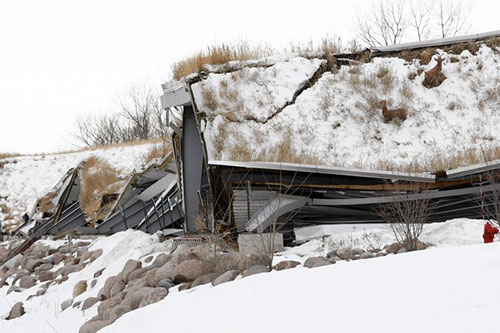
Aquascape Green Roof Failure

--Speculating on why the green roof collapsed in St. Charles, Illinois and who is at fault.


A little over a month ago, the largest sloped green roof in North America collapsed.  There has been speculation as to why this roof collapsed, but no firm conclusions have been made as the investigation continues.  The president of Aquascape, commented on the incident in a press release saying that the snow had melted on the roof but could not drain because of ice blocking the drainage system.  It has been further explained that the sequence of unordinary weather conditions involving almost two feet of snow, freezing temps at night and 40 degree weather the next day, had allowed the circumstance to occur.


While this seems like a likely explanation reinforced by weather data on the corresponding days, I cannot come to agreement with this theory.  As an Architectural Engineering student, I find it hard to believe that not enough safety factors had been built into the structural design of this roof that even if the loads involved were applied, the structure would not fail.  And while green roofs are a newly implemented technology in commercial construction in the United States, I do not think that the engineers handled the calculations incorrectly.  Designing with green roof loads is not very difficult as dead loads (green roof system?s components, thickness of soil, and vegetation per square foot) are fairly uniform.  In addition, the live loads (snow, ice, and maximum water retention of the soil are also uniform and would be designed for peak load simultaneously using even safety factors over 50%.  For this reason the behavior of a green roof and loads applied are known and will be, in essence, over-engineered by code to avoid this type of failure.

Keeping all of this in mind, what else could have caused this collapse if the beam sizes and connections were designed appropriately?

This is the type of question that has construction managers and contractors shaking in their work boots.  As new sustainable technology is implemented into large construction projects there is a lot of room for error.  Rarely, are these failures a result of poor technology, but a lack of compliance to specified installation instructions.  Contractors unfamiliar with this new construction tend to make mistakes that get covered up until forensic investigations uncover them after tragic events.

Incidents such as the Aquascape green roof collapse should not discourage people from using sustainable products and technologies in new buildings but should emphasize the need for construction managers and contractors that are familiar with the new technology.  It will be interesting to see what the forensic investigation concludes.

Source: http://www.sustainableconstructionblog.com/news/aquascape-green-roof-failure

electrician in Columbia VA Columbia electrician electrician Columbia electrician in Columbia electrician Columbia VA

Contractors Can Recover for Public Agency's Failure to Disclose Material Information

By Edward Lozowicki

In a recent decision the California Supreme Court expanded the implied warranty of specification suitability to include claims for a public agency's failure to disclose material information. In doing so it resolved a split in the decisions of the lower appellate courts. Notably, the Court adopts virtually the same rationale recognized by the Federal Circuit and Court of Federal Claims on federal procurement contracts, namely, the "superior knowledge" doctrine. In Los Angeles Unified School Dist. v. Great American Ins., 49 Cal. 4th 738, 2010 WL 2720825 (July 12, 2010), the Court held that a contractor need not prove intentional misrepresentation to recover compensation for a public entity's failure to disclose material information. The Court expressly disapproved Jasper Construction v. Foothill Junior College, (1979) 91 Cal. App. 3d 1, which held to the contrary.
 

Under Los Angeles Unified, recovery is qualified by a four-part test. A contractor may recover from a public entity where: (1) the contractor submitted its bid or undertook to perform without material information that affected costs, (2) the public entity was in possession of the information and was aware the contractor had no knowledge of, nor any reason to obtain, the information, (3) any contract specifications or information furnished by the public entity misled the contractor or did not put it on notice to inquire, and (4) the public entity did not provide the relevant information. Id.

Background

The underlying facts of Los Angeles Unified are straightforward. In 1996, the Los Angeles Unified School District contracted to build an elementary school. Three years later, the District terminated the construction contract declaring the contractor to be in material breach and default. The District then sought bids from contractors, including the plaintiff, to complete the project and repair defects in the existing construction. The plans and specifications available to bidders indicated that the contractor selected would be responsible for both listed and unlisted defects in the "correction list" or "pre-punchlist". After receiving the plans and conducting a site inspection, the plaintiff contractor submitted the winning bid to complete the work for $4.5 million.

Shortly after construction commenced, the contractor discovered defects more extensive than originally presumed. The contractor noted that the existing work had nonconformities that could not have been detected by simple observation and were not indicated in the correction list. For example, the repair of some stucco surfaces would have required replacing not only the stucco, but the underlying exterior wall and material at a greatly increased cost. The contractor sought extra compensation for work necessitated by what it termed "latent defects". The contractor alleged the District had breached the contract by misrepresenting the material facts and conditions of the project, and further, had breached the implied warranty that the plans were a complete and accurate depiction of the project's scope. As an example, the contractor alleged that the District had failed to disclose a consultant's report that would have indicated more significant defects in the existing construction.

The trial court granted the District's motions for summary adjudication and judgment on the pleadings, holding that the contractor had failed to recite facts indicating the District had intentionally concealed information. The California Court of Appeals reversed, reasoning that the contractor could maintain an action for breach of contract if the District "knew material facts concerning the project that would affect [the contractor's] bid or performance and failed to disclose those facts." Los Angeles Unified School Dist. v. Great American Ins. (2008), 163 Cal. App. 4th 944, 965.

Courts of Appeal Split

The Court's opinion in Los Angeles Unified began by affirming the measure of public entity liability set forth by the U.S. Supreme Court in Spearin v. U.S. (1918), 248 U.S. 132. The Spearin Court held that plans and specifications presented by a public entity were impliedly warranted to be correct. Under Spearin, a contractor can recover for an unanticipated increase in cost if this warranty was breached. The California Supreme Court clarified the application of this doctrine in Souza & McCue Const. Co. v. Superior Court (1962), 57 Cal. 2d 508, holding that:
 

"[a] contractor of public works who, acting reasonably, is misled by incorrect plans and specifications issued by the public authorities as the basis for bids and who, as a result, submits a bid which is lower than he would have otherwise made may recover in a contract action for extra work or expenses necessitated by the conditions being other than as represented."
 

Opposing opinions grew out of the California Courts of Appeal in applying this principle to situations where the plans and specifications were correct, but the contractor was misled as a result of material information unintentionally withheld by the public entity. Los Angeles Unified aimed to resolve these conflicting opinions, which are briefly considered below. 

  • Jasper Construction v. Foothill Junior College

In Jasper (1979), 91 Cal. App. 3d 1, a contractor claimed that as a result of inadequate and defective plans for the construction of a school auditorium, it incurred delays and extra expenses. The plans, the contractor claimed, required the contractor to pour concrete by a "wall-to-wall" method, instead of a customary "floor-to-floor" method. The Court of Appeals dismissed the contractors claim against the school district. The Court, applying Souza, held that recovery in a contract action by a contractor of public works is only available where the contractor is misled by incorrect plans and specifications. The application of this rule turned on the definition of misrepresentation, an act requiring some affirmative act. Anything less than a positive act, reasoned the Court, would expose public entities to liability for contractors' lack of diligence in examining plans and specifications.

  • Welch v. State of California

In Welch (1983), 139 Cal. App. 3d 546, a contractor alleged it was misled by the state's failure to disclose information in its possession about similar repairs performed on the site ten years earlier. The Court held that "under certain circumstances, a governmental agency may be liable for failing to impart its knowledge of difficulties to be encountered in a construction project". It found that the state had a duty to disclose information about a prior repair if disclosure would eliminate or materially qualify the misleading effect of the plans and specifications.

  • Thompson Pacific Const. v. City of Sunnyvale

Thompson Pacific Const. (2007), 155 Cal. App. 4th 525, involved a claim by contractor against a city who refused to increase the contract price for the construction of a senior center due to alleged non-conforming construction. Approving of the principle in Welch, the Court noted that "careless failure to disclose information may form the basis for an implied warranty claim if the defendant possess superior knowledge inaccessible to the contractor." Id. at 552. However, the Court also pointed out that Welch was consistent with the general rule that "silence is not actionable." Id.

In Los Angeles Unified, the California Supreme Court attempted to strike a balance between the appellate decisions in Welch and Thompson, that preserved a contractor's cause of action against public entities who unintentionally fail to disclose material facts. The Court expressly rejected Jasper, which held that there must be an affirmative misrepresentation or concealment of fact in order for the contractor to recover.

Adoption of the "Superior Knowledge Doctrine"

In rejecting Jasper, the Court spent little time distinguishing the holding of Jasper itself, relying on other authority to disapprove the opinion that recovery by a contractor must be premised on the affirmative act of misrepresentation. First, Justice Werdegar pointed to California authority upholding judgments against owners for active concealment of material facts. For example, in City of Salinas v. Souza & McCue Const. Co., (1967) 66 Cal. 2d 21, 222-223, the Court of Appeals found a city had affirmatively concealed facts, and further noted that a general rule that "by failing to impart its knowledge of difficulties to be encountered in a project, the owner will be liable for misrepresentation if the contractor is unable to perform." In unintentional concealment cases, like Welch and Thompson, this principle was affirmed where disclosure would have materially qualified the misleading effect of the plans and specifications.

Second, in forming its test for liability, the Court drew on the "superior knowledge doctrine" put forth by the U.S. Court of Claims in Helene Curtis Indus. v. U.S. (Ct.Cl. 1963), 312 F.2d 774. In Helene Curtis, the Court found that the U.S. Army possessed "superior knowledge" that would have alerted bidders to the project's true requirements. The Court held that the Spearin doctrine applied. It reasoned that where a public agency "possess[es] vital information which it was aware the bidders needed but would not have, [it] could not properly let them flounder on their own." Id. at 778. The Los Angeles Unified court thereafter adopted the test articulated by Helene Curtis allowing relief where: (1) a contractor undertakes to perform without vital information or knowledge of a fact that affects performance costs or duration, (2) the public entity was aware the contractor had no knowledge of and had no reason to obtain such information, (3) the contract specifications misled the contractor or did not put it on notice to inquire, and (4) the public entity failed to provide the relevant information. Los Angeles Unified, 2010 WL 2720825 at 7.

Application of the "Superior Knowledge Doctrine"

The opinion in Los Angeles Unified highlights the Court's reliance on the "superior knowledge doctrine" to actions for unintentional misrepresentation. Helene Curtis is factually distinguishable from Los Angeles Unified. In Helene Curtis, the U.S. Army requested a disinfectant composed of a new chemical that it knew needed more processing than revealed in the "skimpy" specifications. 312. F.2d at 775. The Court found that withholding information of this nature may constitute a breach of "an independent duty to reveal data" if it "embodies material misrepresentation misleading the contractor." Helene Curtis, 312 F.2d at 778. In Los Angeles Unified, the specifications indicated that the contractor awarded the job would also be responsible for unlisted defects in existing construction and indicated that defects listed were for general review only. Whereas the U.S. Army sought to withhold information essential to the cost-effective manufacture of the disinfectant in Helene Curtis, the plans and specifications in Los Angeles Unified expressly stated that further defects may exist in the project. Nevertheless, the Court found the superior knowledge of the public agency determinative.

Further, the test articulated in Helene Curtis, and adopted by Los Angeles Unified, relies on the assumption that the public entity knows that the information it possesses may materially affect the contractor's bid or performance on the contract. Similarly, the second element of the test prescribed by Los Angeles Unified, requiring the "public entity was in possession of the information and was aware the contractor had no knowledge of [the information]", appears to make the same assumption. Los Angeles Unified, 2010 WL 2720825, at *7. How will the finder of fact evaluate a public agency's knowledge of materiality?

Totality Of The Circumstances

In practice, the public agency's knowledge that certain information was material and that the contractor had no knowledge of it would likely be proved by direct testimony and circumstantial evidence. On this point the Superior Court noted that any finding of liability for unintentional misrepresentation would be based on the "totality of the circumstances". The circumstances affecting recovery may include: (1) positive warranties or disclaimers made by either party, (2) the information provided by the plans and specifications and related documents, (3) the difficulty of detecting the condition in question, (4) any time constraints the public entity imposed on proposed bidders, and (5) any unwarranted assumptions made by the contractor. As a result, a "public entity may not be held liable for failing to disclose information a reasonable contractor in like circumstances would or should have discovered on its own, but may be found liable when the totality of the circumstances is such that the public entity knows, or has reason to know, a responsible contractor acting diligently would be unlikely to discover the condition that materially increased the cost of performance." Los Angeles Unified, 2010 WL 2720825, at *7.

Conclusion

Los Angeles Unified resolves a split in the Courts of Appeal regarding the liability of public entities for unintentional misrepresentation of material facts to contractors during the bidding process. Practitioners will be paying close attention to the trial court as it applies the Los Angeles Unified ruling on remand. The ultimate judgment will provide the first indication of how trial courts will apply this new liability regime moving forward.

Authored By:

Edward B. Lozowicki is a partner in Sheppard Mullin's San Francisco office, and heads the firm's Northern California Construction Practice Team. The author gratefully acknowledges the assistance of Scott Vignos, in preparing this article.

Source: http://feeds.lexblog.com/~r/ConstructionInfrastructureLawBlog/~3/XkQVjpAqezQ/

electrician Columbia electrician in Columbia electrician Columbia VA electrician in Columbia VA Columbia electrician

A Sustainable Construction Outlook for 2011

2011 buzzwords: net-zero energy, passive house, and photovoltaic.

As we bring in the New Year, there are several trends that will define the construction industry in 2011.  As in recent years, the industry is undoubtedly headed in a sustainable direction focusing on environmentally friendly materials, energy efficiency, and alternative energy sources.  The outlook for the industry in 2011 considers these same principles, but we will see a stronger more informed focus in several areas.

Achieving net-zero energy has become the driving force behind many sustainable projects both commercially and residentially.  Net-zero energy is a term that defines the outcome of a buildings performance due to its energy efficiency based on super-insulation properties combined with alternative energy sources. 

Sustainable construction developments over the past few years have brought us new innovations and technologies that have prepared the industry to take a more feasible approach to redefining building standards.  While the USGBC?s LEED certification standards have been a strong notion to spark the green building revolution, they have also faced a fair share of adversity in 2010.  Adopting energy efficiency and alternative energy guidelines from the LEED standards, and then taking these standards one step higher, leaves us with a new industry wide focus that becomes more budget friendly in an otherwise economically suffering industry.
 
Since net-zero energy is merely a concept; it fundamentally defines an achievable goal that allows architects and engineers to decide how this goal will be reached without being bound by a scorecard of standards.  One set of standards that can be used as a general guideline for super insulation is Passive House.  The Passive House standards are not as complex or demanding as LEED but provide a more beneficial result; one which is crucial in achieving net-zero energy.  Its main goal is to decrease energy loads in the building and meet the new alternative energy technologies halfway for a net-zero energy building performance. 

Looking back on 2010, this outlook can be justified by recalling what the majority of investment and research activity focused on.  The U.S. government, under the American Recovery and Reinvestment Act (ARRA projects), invested in energy reducing electrical and mechanical systems, window and wall insulation research and development, and many photovoltaic products and projects.  As ARRA funding runs out this year, the construction of new bridges and highways will slow down; however, residential and commercial projects are expected to increase.  It will be an exciting year for the construction industry to see these new technologies implemented into state of the art, net-zero projects that will set a new precedent for years to come.

Source: http://www.sustainableconstructionblog.com/construction/a-sustainable-construction-outlook-for-2011

Columbia electrician electrician Columbia electrician in Columbia electrician Columbia VA electrician in Columbia VA

Energy Efficient Lighting Supply


The Sustainable Construction Blog is proud to announce their newest partner, the Energy Efficient Lighting SupplyEnergy Efficient Lighting Supply has recently launched their brand new store of affordable automated lighting supplies for all your energy efficient lighting needs. 

The store features many products, but most proudly offers the lowest prices on occupancy sensor switches.  This modern lighting component can save you loads of money on your energy bills, while providing the interior of your home or office a futuristic, upgraded look.  Occupancy sensors range from ceiling mounted to wall mounted and passive infrared to ultrasonic.  Whether you are looking for residential or commercial use, Energy Efficient Lighting Supply is sure to have you covered.

We are most proud to partner with Energy Efficient Lighting Supply because of their commitment to sustainability and smart DIY renovations.  Keep checking back at 
http://occupancysensorswitch.com for the latest in automated in lighting technology, and their line of LED under cabinet lighting kits and components for your next sustainable kitchen renovation. 

Source: http://www.sustainableconstructionblog.com/news/energy-efficient-lighting-supply

electrician in Columbia VA Columbia electrician electrician Columbia electrician in Columbia electrician Columbia VA

DOE provides $2 billion for solar energy


On Saturday, July 5th 2010, President Obama announced his approval of the DOE loan guarantee for solar energy projects.  This $1.85 billion in funding takes advantage of last year?s American Recovery and Reinvestment Act (ARRA). 

Other recent ARRA projects received a combined total of $76 million a few weeks ago.  These projects received federal funding to produce products that are unique to the sustainable construction industry and also train professionals to be familiar with this equipment and energy efficient building operations.  As all ARRA projects do, this funding ultimately is designed to stimulate the economy with domestic manufacturing, and increased job availability.  It is debated whether or not this money is being well invested in our economy to support these reasons.  However, to the benefit of the sustainable construction industry the loan guarantee has officially been approved. 

A large portion, $1.45 billion dollars, will go to Abengoa Solar.  The funding will set their Solana Project into the construction phase.  The Solana Project, in Gila Bend, AZ, aims to create a large scale solar plant that will produce 280-MW.  The construction will provide 1600 jobs and 85 permanent jobs once it is operational in 2013.  This will be one of the world?s largest solar power plants.  At the expense of over two billion dollars it will serve 70,000 homes. 

This is a strong indication of the initial expense of large-scale alternative energy sources.  It also has something to say about the fact that it is brand new technology.  Hopefully as more large-scale solar plants are built, the price of construction and technology will go down.  However, there is no doubt that developing clean energy sources nationwide will be very expensive and take decades.  This is not based on a forecast that every electrical company needs a solar power plant because this is not possible and doesn?t make sense for many regions of the country; however this caliber of new technology, when produced for large scale grid applications is very expensive. 

The lighter portion of the loan guarantee is a mere $400 million to manufacture thin-film solar panels at two factories.  An old Chrysler factory in Indiana will be the new location for one of the manufacturing plants.  The other factory expansion will be in Colorado.  Abound says it will provide 1500 jobs and continual production of solar panels.  A concern for the investment in Abound is presented when competition is considered.  The solar panel company First Solar already has a low-cost, thin-film panel in production.  Hopefully Abound is capable of producing equivalent technology at a similar price and it may work out that they play against each other to lower their market prices further.

Source: http://www.sustainableconstructionblog.com/news/doe-provides-2-billion-for-solar-energy

electrician in Columbia electrician Columbia VA electrician in Columbia VA Columbia electrician electrician Columbia

Tuesday, May 29, 2012

Tools of the Trade: Modern Marketing for Construction Brands ? Book Now Available

You can now purchase the book�Tools of the Trade: Modern Marketing for Construction Brands. Modern Marketing for Construction Brands covers all aspects of marketing in the construction industry, from building products and equipment, to A/E/C services and retail, along with specfic examples of construction marketing implementation. Construction professionals will learn useful information as it relates [...]

Source: http://constructionmarketingblog.org/tools-of-the-trade-modern-marketing-for-construction-brands-now-available/

electrician Columbia VA electrician in Columbia VA Columbia electrician electrician Columbia electrician in Columbia

Terminology Differences Between a "Bidder" and an "Offeror"

By: Michael H. Payne

Government contractors frequently use incorrect terminology to describe a solicitation. For example, clients often call me and ask why they were not awarded a contract even though they had submitted the lowest bid. The first thing that I ask is whether the solicitation was a Request for Proposals ("RFP"), or an Invitation for Bid ("IFB"). If it was an RFP, the award was probably based on best value and the lowest-priced proposal would not necessarily receive the award. If the solicitation was an IFB, there would be more of a question about why an award was not made to the lowest-priced bidder. Of course, even in sealed bidding the lowest bidder must also be responsive and responsible in order to receive an award, so there can be a valid reason as to why the lowest bidder did not receive the award.

The best way to show that you understand the basics of the federal procurement process is to remember that responses to an IFB (sealed bid solicitation) are referred to as "bids," and responses to an RFP (negotiated procurement) are referred to as "proposals" or "offers." In other words, the proper terms under an IFB are "bid," "bidder," and "sealed bid," and the proper terms under an RFP are "proposal," "offer," and "offeror." Your lawyer will become very confused if you mix these terms by saying, for example, "I just submitted a bid on an RFP." Sometimes, the only way that I can figure out what my client is talking about is to ask for the solicitation number (the "R" or the "B" in the middle will be a dead giveaway), or I may simply ask my client to send me a copy of the solicitation.

Of course, government procurement personnel frequently add to the confusion. RPPs are often referred to as "negotiated procurements" even though there usually are no negotiations (or "discussions"), and contracting officers often refer to both bids and proposals as "bids," To make matters worse, the GAO and the courts refer to protests of either an IFB or an RFP as "bid protests." No wonder there is so much confusion.

Michael H. Payne is the Chairman of the firm's Federal Practice Group and, together with other experienced members of the group, frequently advises contractors on federal contracting matters, including teaming arrangements, negotiated procurements, bid protests, claims, and appeals.

Source: http://feeds.lexblog.com/~r/FederalConstructionContractingBlog/~3/VzZQwwW3wq8/

electrician in Columbia electrician Columbia VA electrician in Columbia VA Columbia electrician electrician Columbia

CONSUMERS BEWARE: the truth about sustainable materials

Sustainable construction materials are becoming more widely developed and produced.  While this is great for the industry these new materials and products for sustainable renovations and new construction must be assessed by consumers and contractors on many different levels.  The problem with the advancing market is that companies start producing items that appeal to green consumers because they merely have to in order to stay in business.  But are these green building products and materials really sustainable?

Truly unique sustainable materials and products are produced locally by companies that are founded on environmentally sound principles.  For example, it is not sustainable to buy bamboo flooring that is manufactured in china, loaded with high VOC epoxy resin and shipped half way around the world.   Bamboo flooring is a sustainable material because it is durable, and grows rapidly in abundance, but supporting a company that harms the earth in such a manner does more harm than good. 

So how does a consumer decide which sustainable renovation materials to choose?

When choosing sustainable materials, spend a good amount of time researching the companies that are producing and providing the products.  As a consumer you can only account for a small percentage of trees that are cut down for your cabinets or flooring.  So mathematically, buying 100 square feet of Brazilian Maple hardwood flooring is negligible when it comes to destroying the rainforest.  And besides, the trees used to make that hardwood flooring have already been cut down when you place your order.  However, by supporting the company you have now given them more money to go out and cut more trees down.  

Remaining on the topic of sustainable flooring, consumers can look for reliable certifications that label certain companies and products that are sustainable.  The Forest Stewardship Council (FSC) is a respected certification service that identifies wood products that come from controlled sources, usually companies that farm their trees, growing as many as they cut down.  One particular type of wood flooring that consistently gets FSC certified is engineered wood flooring.  This flooring is made using a thin lam wood on top of multiple layers of ply.  It dramatically reduces the amount of trees needed to achieve a desired aesthetic in your home and is also very durable,

To summarize, search for sustainable materials and products that not only bring a sustainable asset to your home, but also support sustainable businesses that are caring for the environment in the same way; not just trying to pull in green consumers? money.  

Source: http://www.sustainableconstructionblog.com/renovations/consumers-beware-the-truth-about-sustainable-materials

electrician in Columbia VA Columbia electrician electrician Columbia electrician in Columbia electrician Columbia VA

SBA Updates Set-Aside and Protest Procedures for Women-Owned Small Businesses

By: Edward T. DeLisle

On Thursday, January 12, 2012, the Small Business Administration issued an interim final rule, which alters the protest procedures pertaining to its Women-Owned Small Business (WOSB) Program. The changes serve two primary functions. First, when the SBA implemented the WOSB program by publishing a final rule in the Federal Register on October 7, 2010, it established set-aside thresholds of $5 million for contracts pertaining to manufacturing and $3 million for all other contracts. As part of the new interim rule, those thresholds have increased to $6.5 million and $4 million, respectively, to account for inflation.

Second, the changes ushered in as part of the interim rule, make the protest procedures for the WOSB Program consistent with the SBA’s other set-aside programs. For example, under the procedures that existed before issuance of the interim rule, if a contracting officer received a protest on a WOSB set-aside and, nonetheless wished to make an award, that contracting officer would have to issue a written determination concluding that doing so was required to prevent significant harm to the public interest. This requirement is inconsistent with the procedure outlined for other programs. Under the interim rule, a contracting officer may issue an award, despite a protest, if he or she makes the simple determination that doing so is necessary to protect the public interest.

As there have been few reported protests involving the WOSB Program, the new rules should not cause wide-spread confusion. If you are considering a protest, however, you are encouraged to read the changes and consult with a legal professional if you have any questions.

Edward T. DeLisle is a Partner in the firm and a member of the Federal Contracting Practice Group.

Source: http://feeds.lexblog.com/~r/FederalConstructionContractingBlog/~3/omGz3QaWI4A/

electrician in Columbia electrician Columbia VA electrician in Columbia VA Columbia electrician electrician Columbia

Congress Increases False Claims Liability for Public Works Contractors

By Bram Hanono

The Fraud Enforcement and Recovery Act (FERA)[1] was signed into law in May 2009. Among other significant changes, FERA expanded the grounds for liability under the False Claims Act (FCA).[2] Public works contractors who work on projects funded with federal funds now stand an increased risk for potential liability under the FCA. The FCA now covers, for example, state and local agency projects where the public agency has received a grant of federal funds to build the project. And it includes projects only partially funded by federal money. Accordingly, federal, state, and local contractors should ensure that they have appropriate compliance systems and controls in place to deal with the enhanced FCA.
 

FERA's "Clarifications" to the FCA

One purpose of FERA was to provide clarifications to the FCA, which Congress felt had been made uncertain and watered down by recent court decisions. It does so by clarifying that the FCA covers claims for government money or property: (1) whether or not the claim was presented to a government employee or official; (2) whether or not the government has custody of the money or property; and (3) whether or not the contracting entity specifically intended to defraud the government. FERA accomplishes these expansions by amending the grounds for liability and altering (and adding) key definitions to the FCA.

As revised by FERA, the FCA may be enforced against any person or entity that "knowingly presents, or causes to be presented, a false or fraudulent claim for payment or approval."[3] This language amends the FCA[4] by eliminating the requirement that a claim must be presented to an officer or employee of the government or a member of the U.S. military to impose liability. Similarly, FERA revises the definition of "claim" to include:

any request or demand, whether under a contract or otherwise, for money or property and whether or not the United States has title to the money or property that . . . is made to a contractor, grantee, or other recipient, if the money or property is to be spent or used on the Government's behalf or to advance a Government program or interest . . . where the United States Government provides or has provided any portion of the money or property [or] will reimburse such contractor, grantee, or other recipient for any portion of the money or property[.][5]
 

The effect of this revision was to repudiate the decision in United States ex rel Totten v. Bombardier Corp.[6] In Totten, the D.C. Circuit held that the government had to prove a claim was "presented" to an officer or employee of the government for liability to attach. Now, a "claim" includes requests or demands to a grantee, such as a local public agency which is building a project.

Similarly, FERA's revised definition of "claim" clarifies the Fourth Circuit's holding in United States ex rel. DRC, Inc. v. Custer Battles, LLC[7], in which the Fourth Circuit held that liability under the FCA did not reach claims for payment of funds over which the U.S. had neither title or control. Now, the FCA reaches claims for payment of funds over which the U.S. has neither title or control, as long as the funds are "to be spent or used on the Government's behalf or to advance a Government program or interest." Notably, FERA provides no definition of what it means to "to advance a Government program or interest."

Finally, FERA's clarifications to the FCA effectively overturn the Supreme Court's decision in Allison Engine v. United States ex rel. Sanders.[8] In Allison Engine, the Supreme Court explained that a subcontractor violates the FCA if it submits a false statement to the prime contractor, intending for the statement to be used by the prime contractor to get the government to pay its claim. Now, FERA prescribes FCA liability where a person "knowingly makes, uses, or causes to be made or used, a fake record or statement material to a false or fraudulent claim."[9] This language amends the FCA[10] by eliminating the "to get" and "by the Government" language previously cited in Allison Engine as connoting an intent requirement.

FERA also added a materiality requirement to that section. "Material" is defined as "having a natural tendency to influence, or be capable of influencing, the payment or receipt of money or property."[11] Therefore, under the new provisions, liability exists if the subcontractor's statement has a natural tendency to influence, or is capable of influencing, payment or receipt of money. FERA makes it irrelevant whether the contractor intended that the government rely on the statement in payment of its claim. The FCA now has a much lower standard for bringing a lawsuit.

FERA Expands Liability for "Reverse False Claims"

Another important change to the FCA under FERA expands liability for "reverse false claims." A reverse false claim was previously characterized by the situation where a company used a false statement or record to avoid or decrease an obligation to pay money to the government in order to keep the funds. Now, liability for a reverse false claim exists whenever one "knowingly conceals or knowingly and improperly avoids or decreases an obligation to pay or transmit money or property to the Government."[12] A false statement or record is no longer required for liability to attach.

Further, FERA expanded the definition of "obligation" to include "an established duty . . . arising from . . . the retention of any overpayment."[13] Under this definition, contractors have a duty to determine if any payment by the government or its agents includes an overpayment. If so, the contractor must refund the overpayment. Failure to identify and refund an overpayment may now result in a FCA violation. Contractors and other recipients of government funds must be alert to these obligations. It appears that fraudulent intent is no longer required to establish liability.

Conclusion

Overall, FERA increased the potential for liability under the FCA for government contractors or others who receive federal funds. Contractors that perform public works projects should train key personnel regarding the FCA and put a compliance system and controls in place to deal with the potential liability under the recently enhanced FCA.

Authored By:

Bram Hanono is an associate in Sheppard Mullin's Del Mar office (858) 720-7461.


[1] 123 Stat. 1617.

[2] 31 U.S.C. §§ 3729-3733.

[3] 31 U.S.C. § 3729(a)(1)(A).

[4] Former 31 U.S.C § 3729(a)(1).

[5] 31 U.S.C § 3729(b)(2).

[6] 380 F.3d 488 (DC. Cir. 2004).

[7] 562 F.3d 295 (4th Cir. 2009).

[8] 128 S. Ct. 2123 (2008).

[9] 31 U.S.C. § 3729(a)(1)(B).

[10] Former 31 U.S.C. § 3729(a)(2)

[11] 31 U.S.C § 3729(b)(4).

[12] 31 U.S.C. § 3729(a)(1)(G).

[13] 31 U.S.C. § 3729(b)(3).

Source: http://feeds.lexblog.com/~r/ConstructionInfrastructureLawBlog/~3/aP_LehIIbbE/

electrician Columbia electrician in Columbia electrician Columbia VA electrician in Columbia VA Columbia electrician