Monday, April 30, 2012

Choosing a Low-E Window


In a recent post, we explained the benefits of using DIY low-emissivity coatings to insulate your current windows at the fraction of the cost of replacing them.  But if you are designing a new sustainable building or home and have the opportunity to select your windows from the cutting edge options available today, these general guidelines will help you make logical decisions.
There is a true science behind low-e coatings that bares the necessity of mentioning that no two low-e coatings are created equal.  However, this is not to say that some products are universally better than others, but that selecting the right window depends on the climate it is being installed in and orientation to the sun.  In order to receive maximum energy efficiency, each window on a building should be analyzed independently and fitted with the appropriately insulated window.


Many superinsulated window manufacturers take these factors into consideration to offer a lineup of windows that are optimal for each application. 


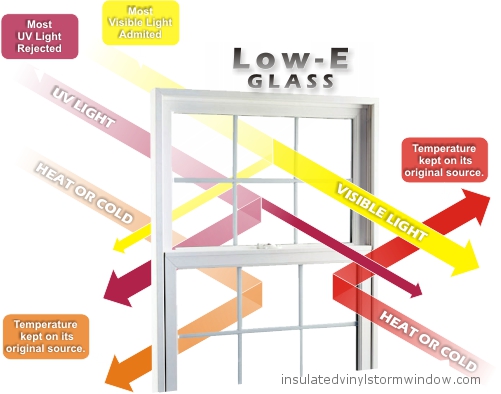
In general, for colder climates, it is desired to encourage long-wave solar heat gain and not let the reradiated heat out of the interior space.  For this application, a low-e hard coat on the inner-most surface of the window would be optimal.  A hard coat is a layer of indium tin oxide that gets floated into the glass when it is still molten.  This allows for more durable surface hence the name hard coat. Compared to soft coats this allows 20-30% more light transmittance, which decreases its insulating R-Value, but encourages passive solar heat gain.  This combined with its application to the inner-most window surface makes it the appropriate choice for colder climates.


For warmer climates, it would be desired to use a soft low-e coating that is typically a spattered layer of silver on the already-hardened pane of glass.  This layer is less durable compared to the hard coat of indium tin oxide, but delivers less light transmittance, thus rejecting more radiant energy from the sun that will contribute to unwanted heat gain in this particular case.  For optimal results this layer should be applied to the outer most surface of the window, but due to the delicate nature of the soft low-e coatings, can be applied to surface #2, just inside the air-space of the window. 


For moderate climates that see a fair share of all four seasons, selecting energy efficient windows becomes more complicated.  In this scenario, it is important to consider each window and its orientation to the sun.  In the northern hemisphere, northern facing windows will never see too much direct sunlight.  Because of this it is not as necessary to have a low light transmittance soft coating, but a well-insulated double or triple pain air-space with a hard low-e coating that will help keep the interior climate constant.


On the contrary, south facing windows might want to encourage solar heat gain for winter months and inhibit solar heat gain in warmer months.  In this case, a well-insulated window is most effective in controlling interior temperatures and the use of low-e coatings is necessary to insulate but the difference in using a soft or hard coat and placement of the coating within the window will be very minimal when evaluated over the course of a year.  There are other measures to be taken in order to create the most energy efficient interior spaces.  Using louvered sun shades and strategically placed operable windows may help to deliver better results as the seasons change.

Source: http://www.sustainableconstructionblog.com/construction/choosing-a-low-e-window

electrician Columbia VA electrician in Columbia VA Columbia electrician electrician Columbia electrician in Columbia

The Year 2010 In Review: Design And Construction Defects Litigation

This article is the first in a series summarizing construction law developments for 2010.

By Candace Matson, Harold Hamersmith & Helen Lauderdale

1. Centex Homes v. Financial Pacific Life Insurance Co., 2010 U.S. Dist. LEXIS 1995 (E.D. Cal. 2010)
 

After settling numerous homeowners' construction defect claims – and more than ten years after the homes were substantially completed – a home developer brought suit against one of the concrete fabrication subcontractors for the development seeking indemnity for amounts paid to the homeowners, as well as for damages for breach of the subcontractor's duties to procure specific insurance and to defend the developer against the homeowners' claims. The subcontractor brought a motion for summary adjudication on the ground the developer's claims were barred by the ten year statute of repose contained in Code of Civil Procedure Section 337.15.
 

The District Court agreed the developer's claim for indemnity was barred by Section 337.15. And it held that because the damages recoverable for breach of the subcontractor's duty to purchase insurance are identical to the damages recoverable through the developer's indemnity claim, the breach of duty to procure insurance claim also was time-barred. The District Court, however, allowed the claim for breach of the duty to defend to proceed. The categories of losses associated with such a claim (attorneys' fees and other defense costs) are distinct from the damages recoverable through claims governed by Section 337.15 (latent deficiency in the design and construction of the homes and injury to property arising out of the latent deficiencies).
 

2. UDC – Universal Development v. CH2M Hill, 181 Cal. App. 4th 10 (6th Dist. Jan. 2010)


Indemnification clauses in construction agreements often state that one party to the agreement – the "indemnitor" – will defend and indemnify the other party from particular types of claims. Of course, having a contract right to a defense is not the same as actually receiving a defense. Any indemnitor attempting to avoid paying for defense costs can simply deny the tender of defense with the hope that when the underlying claim is resolved the defense obligations will be forgotten. In the past, when parties entitled to a defense – the "indemnitees" – had long memories and pressed to recover defense costs, indemnitors attempted to justify denying the tender by claiming their defense obligations coincided with their indemnity obligations and neither arose until a final determination was made that the underlying claim was one for which indemnity was owed.

The California Supreme Court rejected this justification for denying an immediate defense obligation in Crawford v. Weather Shield, 44 Cal. 4th 541 (2008). And in UDC – Universal Development vs. CH2M Hill, 181 Cal. App. 4th 10 (2010), the Sixth District Court of Appeal followed the Supreme Court's lead, repeating that the right to a defense is separate and distinct from the right to indemnity under a typical indemnity clause, the right arises immediately upon assertion of a claim, and the right exists regardless of whether the claim is ultimately proven.

UDC was the developer of a condominium project. It contracted with CH2M Hill to provide engineering and environmental planning services for the project. Their agreement called for CH2M Hill to indemnify UDC for all claims "that arise out of or are in any way connected with any negligent act or omission" of CH2M Hill. It also required CH2M Hill to provide UDC with a defense to any action brought on any claim covered by the indemnity obligation. After the project was completed, the homeowners' association filed suit against UDC for defective conditions at the project due in part to negligent planning and design of open spaces and common areas. The complaint did not attribute negligence to any particular subcontractor but instead contained general allegations of deficient services by architects, engineers, and consultants.

UDC filed a cross-complaint for equitable, comparative, and express contractual indemnity against numerous subcontractors on the project, including CH2M Hill. It also tendered the defense of the homeowners' association's lawsuit to all cross-defendants. CH2M Hill declined the tender. UDC succeeded in settling all of the cross-claims except those asserted against CH2M Hill.

At trial, the parties agreed the jury would decide the factual issues of negligence and breach of contract and the court thereafter would apply the contract's indemnity provisions. The jury concluded CH2M Hill had not been negligent and had not breached its contract with UDC. With these favorable conclusions in hand, CH2M Hill argued to both the trial and appellate courts that it had no duty to defend UDC. According to CH2M Hill, such a duty could only arise after a finding that CH2M Hill had been negligent.

Both the trial and appellate courts rejected CH2M Hill's argument. Instead, they ruled that a duty to defend is separate from a duty to indemnify, and the duty to defend necessarily occurs before the duty to indemnify arises and before any negligence determination is made. CH2M Hill also unsuccessfully urged the courts that it owed no duty to defend the developer because the homeowners' association's complaint did not specifically allege that CH2M Hill was negligent. The appellate court concluded that the developer's right to a defense did not turn on whether the plaintiff named a particular subcontractor in its complaint. The plaintiff's general allegations of deficient design services by engineers for the project, together with the developer's cross-complaint for indemnity attributing responsibility to CH2M Hill for the plaintiff's damages, were sufficient to trigger CH2M Hill's duty to defend.

The UDC and Crawford decisions eliminate any lingering uncertainty about when the obligation to provide a defense arises: under a typically worded indemnity clause, the duty to defend requires immediate action by an indemnitor after the defense of a claim is tendered. But whether these decisions will alter real world conduct by indemnitors and result in their taking an active responsibility for the defense of claims from the outset is far less certain.
 

3. Great Lakes Construction, Inc. v. Jim Burman, et al., 186 Cal. App. 4th 1347 (3d Dist. July 2010)
 

After a homeowner posted unfavorable comments about two contractors on the internet, the contractors sued the homeowner for libel. The contractors' complaint prompted a predictable series of pleadings, starting with the homeowner's cross-complaint for breach of contract and negligence against the contractors and designers for substandard work, followed by the contractors' cross-complaint against one of its subcontractors for breach of contract and indemnity. In the ensuing litigation, the homeowner and subcontractor were represented by the same attorney. The contractors successfully moved to disqualify the lawyer for the homeowner and subcontractor based on the conflict that existed in the lawyer's joint representation of them. The Court of Appeal reversed. No legally protected interest of the contractors was violated by the joint representation of their opponents by a single lawyer; the lawyer owed the contractors no duty of loyalty. Therefore the contractors did not have standing to seek the lawyer's disqualification.

Authored By:

Candace L. Matson is a partner in Sheppard Mullin's Los Angeles office where she specializes in construction law.  Harold E. Hamersmith is a partner in the firm's Los Angeles office specializing in design and construction contracts, claims, and defects litigation, and public contract law.  Helen J. Lauderdale is a special counsel specializing in construction litigation in Sheppard Mullin's Los Angeles office.

Source: http://feeds.lexblog.com/~r/ConstructionInfrastructureLawBlog/~3/dR4jSnA0bCA/

Columbia electrician electrician Columbia electrician in Columbia electrician Columbia VA electrician in Columbia VA

Strategic Marketing for Construction Brands ? FREE Webcast!

Webcast – Thursday, March 15, 2012 A webcast from the Construction Marketing Association (CMA) will address the challenge of strategic marketing for construction brands, and offer guidance on how to achieve market growth. The free webcast for members and non-members is scheduled for Thursday, March 15, 2012, at 1 pm CST. CMA Chairman Neil M. [...]

Source: http://constructionmarketingblog.org/strategic-marketing-for-construction-brands/

Columbia electrician electrician Columbia electrician in Columbia electrician Columbia VA electrician in Columbia VA

5 questions with ZamRay.com


ZamRay.com is quickly becoming a popular name within the sustainable construction industry and for good reason.  ZamRay offers unique services in one convenient location that can effectively connect the construction industry.  While the main purpose of this internet start up is to allow its users to buy and sell surplus and reclaimed material, there are many other components of the website that make it a useful source to improve construction projects across the nation.

Earlier this week I had a chance to converse with the founder and managing director of ZamRay, Kurt Fisher.  The following Email interview with Kurt reveals a unique and in-depth outlook of what ZamRay has accomplished and their plans for the future.

Interview with Kurt Fisher, founder/managing director of Zamray.com

Since its soft launch earlier this year, many additions have been made to ZamRay.com.  What aspect of ?connecting the construction industry? do you pride yourself on the most?  In other words, which feature of the website do you feel is most powerful in connecting the industry?

The ability for contractors and distributors to finally have a reputable venue to buy and sell their surplus materials has and always be our cornerstone service.  It?s what makes us unique.

Our discussion forum and articles sections where you can choose to write or post something in over 30 industry-specific categories is going to be very popular.

Just the fact there is something on ZamRay for everyone on ZamRay, whether you are the CEO or a large General contractor or the smallest of tradesmen working with one truck.
Finally, I think our social media connectivity is proving to be very popular.

It is not hard to see how ZamRay offers services to the construction industry that can greatly contribute to sustainable construction projects.  In addition to the support of the Sustainable Construction Blog, have you made any connections to other affiliations in the sustainable construction industry?

Yes!  We are now members of the USGBC and we are in the process of getting heavily involved with the local USGBC chapter in our hometown of Denver, CO.   We are also working on trying to figure out a way for when building owners use ZamRay for buying or selling recycled materials in can count towards LEED certification points or credits.
 
ZamRay has been referred to as the Craigslist of the construction industry.  In what ways does ZamRay make it easier and more practical for contractors to buy and sell surplus material?

Well for one it says a lot when we are referred to as the Craig?s List of the industry!

1.  Simplicity ? Anything we put on our site has to be simple for people to use.  Our buy and sell functionality was designed with that in mind where it is extremely easy to place and view ads

2.  Search capabilities ? The key to our buy/sell process is how simple and granular you can get on searching for material.  Especially in the electrical industry, where there are over 10,000 parts & pieces and being able to search by a part#, size, location is absolutely huge.

3.  It?s practical because there is an obvious void in the buy/sell.  Having been on both the contracting side and distribution side of the industry I experienced first-hand all the left over material that goes to waste.  If you can buy or sell something for 40 to 60 cents on the dollar why wouldn?t you.


I see ZamRay.com is becoming very popular and has accumulated quite a few votes for the CONEXPO?s most innovative product/technology.  Are there any new updates to the website that will be revealed at the show in Las Vegas next week?

We were hoping to have our Mobile App on I-Pad and I-Phone ready to launch but we are not quite there yet.  We have a new fun & interactive section to our website that we just implemented.  Other than that we are just going to promote how successful ZamRay has been since its inception January 6th.   There aren?t many websites that can say they have had 70,000 page views in their first 9 weeks.

-----------------------------------

A big thanks to Kurt Fisher and our friends at ZamRay for taking the time to conduct this interview.  Their work is appreciated in the sustainable construction industry and we wish with them the best of luck in their continued endeavors.  Please support ZamRay.com by visiting their website and signing up as a registered user.

Source: http://www.sustainableconstructionblog.com/news/5-questions-with-zamray-com

electrician in Columbia VA Columbia electrician electrician Columbia electrician in Columbia electrician Columbia VA

The Time to File a Bid Protest

By: Michael H. Payne

The GAO requires, as provided in 4 CFR 21.2, that:

(a)(1) Protests based upon alleged improprieties in a solicitation which are apparent prior to bid opening or the time set for receipt of initial proposals shall be filed prior to bid opening or the time set for receipt of initial proposals. In procurements where proposals are requested, alleged improprieties which do not exist in the initial solicitation but which are subsequently incorporated into the solicitation must be protested not later than the next closing time for receipt of proposals following the incorporation.

(2) Protests other than those covered by paragraph (a)(1) of this section shall be filed not later than 10 days after the basis of protest is known or should have been known (whichever is earlier), with the exception of protests challenging a procurement conducted on the basis of competitive proposals under which a debriefing is requested and, when requested, is required. In such cases, with respect to any protest basis which is known or should have been known either before or as a result of the debriefing, the initial protest shall not be filed before the debriefing date offered to the protester, but shall be filed not later than 10 days after the date on which the debriefing is held.

Of course, filing a GAO protest may not achieve any meaningful relief unless the project is stayed pending resolution of protest. In this regard, FAR 33.104(c) provides that "When the agency receives notice of a protest from the GAO within 10 days after contract award or within 5 days after a debriefing date offered to the protester for any debriefing that is required by 15.505 or 15.506, whichever is later, the contracting officer shall immediately suspend performance or terminate the awarded contract," except when the interests of the United States will not permit waiting for a GAO decision. The key here is that, in a negotiated procurement, the agency must have received notice from the GAO within five days after the debriefing. That means that the protest needs to be filed as quickly as possible after the debriefing in order for there to be any realistic possibility that the GAO will notify the agency in time. In our experience, when agencies receive notice even one day late, they will refuse to impose a stay.

The rigid timeliness requirements of the GAO often lead protesters to file bid protests in the United States Court of Federal Claims where there is no 10-day, or 5-day, time limit, and where a debriefing is not a prerequisite to filing a protest on a negotiated procurement. The downside, however, is that the Court does not grant an automatic stay and a protester must file a motion for a temporary restraining order in order to halt further performance pending resolution of the protest. In our experience, the government frequently agrees to voluntarily stay performance once the protest is filed (often at the urging of the judge) and a TRO hearing is not always required.

It should also be noted that if a protest involves a matter that should have been raised prior to bid opening, or prior to the date for receipt of proposals, such as a challenge to the terms of the solicitation, a protest filed after award will be dismissed as untimely. The Court of Appeals for the Federal Circuit has held that “a party who has the opportunity to object to the terms of a government solicitation containing a patent error and fails to do so prior to the close of the bidding process waives its ability to raise the same objection subsequently in a bid protest action in the Court of Federal Claims.” (See Blue and Gold, 492 F.3d 1308). Accordingly, contractors should consult with legal counsel to be certain that all of the procedural requirements of a protest have been met.

Michael H. Payne is the Chairman of the firm's Federal Practice Group and, together with other experienced members of the group, frequently advises contractors on bid protests and federal construction matters.

Source: http://feeds.lexblog.com/~r/FederalConstructionContractingBlog/~3/csxynvoNC4Y/

Columbia electrician electrician Columbia electrician in Columbia electrician Columbia VA electrician in Columbia VA

Sunday, April 29, 2012

Sustainable Construction Photos at the 2012 Olympics

As London prepares to host the Summer Olympic Games of 2012, recent construction photos share the progress being made in this sustainable project.  This sustainable planning and construction project will develop an area that is economically depressed to provide for the community for many decades after the 2012 Olympic Games are over.  Photos courtesy of london2012.co.uk

Velo Park

Aquatic Center

Olympic Village

Source: http://www.sustainableconstructionblog.com/construction/sustainable-construction-photos-at-the-2012-olympics

Columbia electrician electrician Columbia electrician in Columbia electrician Columbia VA electrician in Columbia VA

Smart Home Renovations


Respect the Environment while you improve your home

A sustainable home renovation can range from upgrading windows and insulation to replacing the flooring with eco-friendly materials. The first tenet of green building is to conserve energy in every way you can: through the course of the renovation and in your daily living, the way your home uses and saves energy will determine just how sustainable your living space has become.

When renovating, you should use materials that have been recycled, re-purposed or harvested from a renewable resource, but a truly green living environment must take some other things into consideration. For instance, the energy and materials that go into recycling, production and shipping can negate the environmental concern that went into the product design, so you'll need to shop with some background knowledge and a careful eye.

Insightful Designs for a Greener Home

If you're making a few small upgrades, choose wisely when replacing each type of fixture, structure or decoration. Low-flow plumbing fixtures, no-VOC paint, recycled wood floor planks and tight fitting, low energy replacement windows are all better choices than their conventional counterparts. Whichever material you decide on, make sure to look a little deeper than the buzz words on the label: supporting harsh chemicals, extraneous packaging and companies that are merely riding the green building wave without living up to their manufacturing responsibilities will counteract your best intentions.

Is Wood a Wasteful or Prudent Choice?

If you're planning a big renovation like an addition or an overhaul of the interior, you'll probably need a good amount of wood. While new wood can be environmentally destructive, some wood is actually a very sustainable choice: products created from farmed wood are often more eco-friendly, as many of these companies will plant a tree for each one that they take from the ground. Alternatively, you can opt for a hardwood substitute like engineered wood, cork or bamboo that has been grown organically in order to reap the rewards of wood without the negative environmental effects.

Supporting environmentally-sound tree farming is a step in the right direction, but there is a more sustainable wood source available. Reclaimed wood is growing in popularity, and for good reason: not only is old wood durable, rustic and unique, but taking it from riverbeds, old barns and rediscovered furniture has virtually zero impact on new growth and the land around you. If you're having trouble finding the wood you need, why not visit a construction site where they will cast aside perfectly usable pieces, or else visit a farm and ask about any old barns or sheds that have been dismantled. A little searching can go a long way, so commit some time now to enjoy a greener home in the future.

Source: http://www.sustainableconstructionblog.com/renovations/smart-home-renovations

Columbia electrician electrician Columbia electrician in Columbia electrician Columbia VA electrician in Columbia VA

Construction Arbitration Clause Calling for Expanded Judicial Review Must be Explicit and Unambiguous

By Robert Sturgeon

Parties to construction arbitrations who are disappointed with the arbitrator's award are often doubly-disappointed to learn that they have very little chance of successfully appealing in a court to overturn the arbitrator's decision. Because arbitration is intended to be a final and complete alternative dispute resolution process, judicial review of the arbitrator's award is quite limited. Ordinarily a court may not review the merits of the dispute, or overturn an arbitration award on ground that the arbitrator made legal errors or erred in applying the law to the facts. In general, a court is authorized to overturn an arbitration award only where (i) the award was procured by corruption or fraud; (ii) there was corruption or misconduct by the arbitrator, (iii) the arbitrator exceeded his or her powers, (iv) the arbitrator refused to postpone the hearing despite there being good cause to do so and that prejudices the parties, or (v) the arbitrator failed to disclose potential grounds on which he or she could be disqualified or refused to disqualify himself when there was cause to do so. See, e.g., Cal. Civ. Proc. Code 1286.2.
 

To expand the scope of judicial review beyond these parameters and obtain something akin to an ordinary right of appeal, parties have attempted to "contract around" the statutory provisions, and have included language in their arbitration agreements providing for appeal or judicial review of the substance of the arbitrator's decision. In a recent decision, the California Court of Appeal held that to be enforceable, an agreement for expanded scope of judicial review of the arbitrator's award must be explicit and unambiguous, and language in the arbitration agreement stating that the arbitrator must render an award "in accordance with substantive California law" is not sufficient. Gravillis v. Coldwell Banker Residential Brokerage Company, 182 Cal. App. 4th 503 (2010).

In Gravillis, the plaintiff had purchased a home using a standard form California purchase agreement which included a clause requiring arbitration of any disputes arising out of the agreement. The arbitration clause stated that the arbitrator "shall render an award in accordance with substantive California law." 182 Cal. App. 4th at 508. Before he moved into the home, plaintiff discovered it had extensive structural damage which left it essentially uninhabitable. Plaintiff filed a lawsuit in court against his real estate brokers for failing to disclose the structural defects. Based on the arbitration clause in the purchase agreement, the trial court ordered the case to arbitration. After a hearing, the arbitrator issued an award in favor of the plaintiff and awarded him damages and costs. The brokers petitioned the court to vacate the award, contending that the arbitrator had made substantive legal errors by (i) finding the brokers had breached a fiduciary duty to plaintiff, (ii) awarding the plaintiff "benefit of the bargain damages" rather than "out of pocket expense" damages; and (iii) awarding the plaintiff his costs incurred in the arbitration. The trial court denied the brokers' petition, and the brokers appealed. On appeal, the brokers asserted they were not subject to the general rule or non-reviewability, but were entitled to have the award overturned on the merits based on the arbitrator's legal errors because the arbitration agreement stated that the arbitrator was required to render an award "in accordance with substantive California law."

The Court of Appeal first emphasized the reasoning underlying the general rule -- because parties to arbitration have a right to expect the arbitration will be a final and binding resolution of their dispute, as a general matter, "the merits of the controversy between the parties [in arbitration] are not subject to judicial review," and the "courts will not review the validity of the arbitrator's reasoning." 182 Cal. App. 4th at 514. The brokers argued that because the arbitrator had made legal errors which were "not in accord with substantive California law," the arbitrator had "exceeded his powers" within the meaning of Code of Civil Procedure § 1286.2, and therefore the award could be vacated under the statutory provisions. The Court of Appeal rejected this contention, explaining that an arbitrator exceeds his or her powers when the arbitrator acts without subject matter jurisdiction, decides an issue that was not submitted to arbitration, upholds an illegal contract, issues an award that violates a statutory right or well-defined public policy, or selects a remedy that is not authorized by law or rationally related to the contract. 182 Cal. App. 4th at 511. The court held that the language requiring the award be "in accordance with substantive California law" was not sufficient to convert ordinary legal errors of the sort alleged by the brokers into acts in excess of the arbitrator's powers.

The court further explained that while California law allows parties to cases governed by the California Arbitration Act to contract for expanded judicial review, because a main purpose of arbitration is to avoid the judicial process, the bar for allowing expanded judicial review of the award is high. First, the arbitration agreement must be governed by the California Arbitration Act rather than the Federal Arbitration Act ("FAA") -- federal law does not allow parties to contract for an expanded scope of judicial review. 182 Cal. App. 4th at 518; Hall Street Associates LLC v. Mattel, Inc. (2008) 552 U.S. 576. Thus, for example, if the agreement states elsewhere that it is governed by the FAA, it will not qualify for expanded judicial review. Second, "to take themselves out of the general rule that the merits of the award are not subject to judicial review, the parties must clearly agree that legal errors are an excess of arbitral authority that is reviewable by the courts." 182 Cal. App. 4th at 516 (quoting Cable Connection, 44 Cal. 4th at 1361). Hence, an arbitration agreement which states that "[t]he arbitrators shall not have the power to commit errors of law or legal reasoning, and the award may be vacated or corrected on appeal to a court of competent jurisdiction for any such error" is sufficient to allow for judicial review of the substance of the award under California law. Cable Connection, Inc. v. DIRECTV, Inc., 44 Cal. 4th 1334, 1342 n. 3 (2008).

However, language in an arbitration agreement requiring that the arbitrator render an award "in accordance with substantive California law" does not meet that standard. That language does not expressly deprive the arbitrator of the power to commit legal error, nor does it expressly and unambiguously authorize a court to review the award for legal or other substantive error. Id. at 518-519. PRACTICE TIP: Contractors and developers seeking expanded judicial review of the award should include language in their contracts stating that the arbitrators do not have the power to commit errors of law, that the award can be vacated for such errors, and that arbitration is to be governed by the California Arbitration Act.

Authored By:

Robert Sturgeon


Source: http://feeds.lexblog.com/~r/ConstructionInfrastructureLawBlog/~3/uJ7qURQqi8c/

electrician in Columbia VA Columbia electrician electrician Columbia electrician in Columbia electrician Columbia VA

Senate Bill Introduced to Combat SBA Fraud

By: Edward T. DeLisle

Senator Olympia Snowe, R-Maine, introduced a bipartisan bill on Thursday that is designed to combat fraud and abuse in the world of small business contracting. As we have reported, the General Accounting Office (GAO) has issued a number of reports over the last several years detailing the existence of fraud in the HUBZone, Service-Disabled, Veteran-Owned Small Business (SDVOSB) and 8(a) programs. These reports have generated much discussion about the need to revamp the system and, in certain circumstances, talk has led to action. The implementation of the current SDVOSB verification system is but one example of the government’s response to the current state of affairs. S. 633, entitled the “Small Business Contracting Fraud Prevention Act of 2011” (Fraud Prevention Act), is designed to take the government’s ability to respond to fraud and abuse in small business contracting to a new level.

As reported by Law360, the Fraud Prevention Act contains three key provisions:

     1. It calls for the development of an oversight structure within the Small Business Administration (SBA) that would allow for better enforcement of the rules governing small business contracting;

     2. It would allow for an increase in criminal prosecutions, suspensions and debarments for those who violate the rules; and

     3. It would require the SBA to issue annual reports to Congress regarding those who are suspended, debarred or referred to the Department of Justice for prosecution.

S. 633 is yet another step to close the loopholes that have developed in the federal government’s small business contracting system. We will track this legislation and report any further developments.

Edward T. DeLisle is a Partner in the firm and a member of the Federal Contracting Practice Group.

Source: http://feeds.lexblog.com/~r/FederalConstructionContractingBlog/~3/Nbe7LiL0GKY/

electrician Columbia electrician in Columbia electrician Columbia VA electrician in Columbia VA Columbia electrician

The Year 2010 In Review: Contractor Licensing

This article is the second in a series summarizing construction law developments for 2010.

By Candace Matson, Harold Hamersmith & Helen Lauderdale

1. Loranger v. Jones, 184 Cal. App. 4th 847 (3d Dist. May 2010)


Jones, a licensed contractor, had a workers' compensation policy covering his employees. Jones unknowingly used an unlicensed subcontractor and knowingly permitted two minors without work permits, and another person without a contractor's license, to help perform work for Loranger. Loranger refused to pay the final invoice and Jones filed suit for breach of contract. Loranger cross-complained alleging defects and sought disgorgement of monies paid. 
 

However, the Court of Appeal, affirming the trial court, held that Jones' license had not been automatically suspended under Business and Professions Code Section 7125.2 and accordingly, Jones was not subject to the sanctions of Section 7031 subdivisions (a) and (b). Loranger largely relied upon Wright v. Issak, 149 Cal. App. 4th 1116 (6th Dist. 2007) in arguing that Jones could not bring suit and was subject to disgorgement. However, the Court found Wright distinguishable because in that case the contractor intentionally reported zero payroll to avoid obtaining workers' compensation insurance. In the instant case, however, Jones had workers' compensation coverage when he began the project. At worst there may have been a lapse of coverage; however, without notice of a lapse of coverage from the registrar, there was no effective suspension of the contractor's license. The Court also expressly rejected a reading of Wright to find "any" underreporting of payroll tantamount to a failure to obtain workers' compensation coverage and thus an automatic suspension of a contractor's license.
 

2. In re Yehuda Sabban, 600 F.3d 1219 (9th Cir. BAP, April 2010)


A homeowner won a judgment against an unlicensed contractor under Business and Professions Code Sections 7031(b) (disgorgement for non-licensure) and 7160 (contract induced by falsity or fraud) in state court. After the trial, the contractor filed for bankruptcy under Chapter 7 of the Bankruptcy Code (liquidation of all non-exempt personal property to pay off creditors). The individual filed an adversary action to determine the dischargeability of the debt. He argued that both awards imposed a remedy for violations of statutes punishing the contractor for debts obtained by fraud and therefore, pursuant to 11 U.S.C. § 523(a)(2)(A), those debts were not dischargeable. The bankruptcy court partially rejected that argument, holding that the 7031(b) award was dischargeable and finding the smaller award under 7160 was non-dischargeable. The Ninth Circuit, in affirming the bankruptcy court ruling, held that the 7031(b) award was not traceable to fraud, and was not premised on fraud, and so it was dischargeable. Thus, an award against an unlicensed contractor under Business and Professions Code Section 7031(b) is dischargeable in bankruptcy.
 

3. Alatriste v. Cesar's Exterior Designs, Inc., 183 Cal. App. 4th 656 (4th Dist. April 2010)


A homeowner employed a landscaping contractor which it knew did not have a contractor's license at commencement of work. The contractor stopped work when the homeowner refused to make payments. The homeowner brought suit to recover the money he had already paid to the contractor. The contractor contended that the homeowner's claim was barred because he knew about the contractor's unlicensed status.

The Court of Appeal rejected the contractor's argument, stating that Business and Professions Code Section 7031(a) provides a complete defense to a claim for payment from an unlicensed contractor, even when the customer knew the contractor was unlicensed. The Court applied that rationale to the "sword provision" of 7031(b), holding that knowledge of unlicensed status does not provide a defense to a claim for disgorgement of payments made for unlicensed work. Furthermore, the Court rejected the contractor's argument that it was entitled to retain payment for work performed after it obtained a license, noting that 7031(b) provides for disgorgement if a contractor was unlicensed at any time during the performance of work. The homeowner was entitled to recover the total amount paid, including payment for materials.
 

4. UDC-Universal Development, L.P. v. CH2M Hill, 181 Cal. App. 4th 10 (6th Dist. Jan. 2010), rev. denied, 2010 Cal. LEXIS 4141


UDC-Universal Development, L.P. entered into two contracts with CH2M Hill, pursuant to which CH2M agreed to provide engineering and environmental planning services for UDC's condominium development. The contracts included an indemnity provision that covered all of UDC's losses to the extent that they arose from, or were connected to, any negligence or omission by CH2M. A duty to defend clause obligated CH2M to defend any suit, action or demand brought against UDC on any claim "covered herein" upon written request from UDC. After completion of the development, the homeowners association brought suit against UDC for "defective conditions" due in part to negligence attributable to CH2M. CH2M rejected UDC's tender of defense, and UDC cross-complained against CH2M for indemnity.

CH2M argued that UDC's indemnity claim was barred because UDC lacked a contractor's license when it entered into the contracts. However, the Court of Appeal held that the term "compensation" as used within Business and Professions Code Section 7031(a) means sums claimed as an agreed price or fee earned by performance, and not indemnification for claims related to a subcontractor's work. Accordingly, the Section 7031(a) bar on actions to recover compensation for work performed by an unlicensed contractor does not apply where the contractor is seeking indemnity for damages paid as a result of a subcontractor's defective work. Regardless of whether a developer is properly licensed, where a contract imposes on a subcontractor a duty to defend against any claim implicating the subcontractor's work, the duty arises as soon as a defense is tendered. 
 

5. Licensing Now Available to LLCs (SB 392)


Effective January 1, 2011, section 7025 of the Business & Professions Code is amended to allow limited liability companies to obtain contractor licenses in California. The License Board is required to begin processing applications therefor not later than January 1, 2012. In order for an LLC to hold a license, it must file and maintain a surety bond in the amount of $100,000 for the benefit of employees to ensure payment of wages and fringe benefits (in addition to the contractor’s license bond required of all licensees.) Further, if the LLC is a signatory to a collective bargaining agreement, the new bond must cover fringe benefit trust fund contributions. Finally, a licensed LLC must maintain and furnish proof of specified insurance coverage in an amount between $1-5M, depending on the number of personnel of record.

Authored By:

Candace L. Matson is a partner in Sheppard Mullin's Los Angeles office where she specializes in construction law.  Harold E. Hamersmith is a partner in the firm's Los Angeles office specializing in design and construction contracts, claims, and defects litigation, and public contract law.  Helen J. Lauderdale is a special counsel specializing in construction litigation in Sheppard Mullin's Los Angeles office.

Source: http://feeds.lexblog.com/~r/ConstructionInfrastructureLawBlog/~3/bYkIop3uarw/

electrician Columbia VA electrician in Columbia VA Columbia electrician electrician Columbia electrician in Columbia
Porter-Cable 18V Drill/Driver Giveaway

Source: http://feedproxy.google.com/~r/feedburner/SETh/~3/jtgL3-_mEEA/

electrician Columbia electrician in Columbia electrician Columbia VA electrician in Columbia VA Columbia electrician

Saturday, April 28, 2012

5 Components of a Net Zero Energy Building

--Unfortunately, there is not a recipe for constructing a net zero energy building, but these guidelines provide a fundamental basis of how net zero energy is acheived through smart design and innovative technologies.

Alternative Energy Source

Alternative energy can come from a variety of sources: solar, wind, geothermal, and biomass.  These renewable energy sources can be harnessed in a variety of ways to provide power, heating, and cooling to a building and lower supplemental consumption by traditional grid utilities. The most influential factor in acheiving net zero energy in a building is choosing what type and how much alternative energy will be used.  Simply put, the alternative energy  source should be chosen based on the natural resources offered by the particular region of the world the building site is located.  A marine or coastal building site might consider wind while a tropical site might consider solar, and an inland moderate site may want to explore the local geothermal resources.  These are by no means strict guidelines for choosing a source but offer a logical basis of how to choose which source a feasibility analysis should be performed on.

In addition to an alternative energy source, other sustainable construction design, technologies and components must be used in order to further lower a building's demand of traditional grid utilities.

Passive Solar Design

One aspect of building design that has been around for hundreds of years but is very underconsidered is how the building will behave according to the sun.  Solar gain is responsible for heat gain that can drive the costs of cooling a building through the roof.  On the other hand the sun offers valuable natural light, and solar gain in the winter can help to heat a building.  Passive solar refers to a building's ability to naturally collect, store and distribute energy as needed according to a builing site's particular climate. 

Paying close attention to the building's orientation on the site, and window and door placement is essential to passive solar design.  In addition it is important to use components of a high performance building envelope, further reducing energy loads to create a net zero energy building. 

High Performance Building Envelope

Today, many building materials and technologies are designed to contribute to a building's ability to lower heating and cooling loads.  The concept of superinsulation is to make a building as air-tight as possible.  This can be done by adding multiple high performance insulations to a traditional structure, or by using panelized or site casted wall systems that eliminate thermal bridging while offering sound structural performance.  These non traditional wall structural systems are structural insulated panels (SIPs) and insulated concrete forms (ICFs).  Unfortunately, these panels can not alone be responsible for creating a superinsulated envelope as windows and doors will likely be present on everyside of the building.  The highest whole wall R-value is acheived by using SIPs and ICFs in combination with superinsulated doors and windows

Lighting and Daylighting

In commercial buildings, only one energy load is more demanding than heating and cooling individually.  That is the energy consumed by lighting.  In recent years, lighting products and systems have improved significantly to contribute to lower demands.  Of course, using no artificial lighting at all is the most beneficial to lowering consumption.  A typical net zero energy building will effectively allow daylight to penetrate deep into highly occupied spaces, and employ a high-tech sensored lighting system that adjusts artificial lighting output based on the amount of daylight present.  In addition, occupancy sensors can be used for areas that do not constantly need to be lit.  Of course, the artificial light source itself can draw less power when CFL adn LED bulbs are used.

Low Consumption Technology/Appliances

Other than lighting, additional electrical consumption comes from appliances and office equipment.  Fortunately, many manufacturers accross many industries have sustainability initiatives that focus on lowering the power consumed by their products.  Many rating systems such as the U.S. Government's Energy Star program make it simple for consumers to choose the right products that will help to acheive a net zero energy goal.

Source: http://www.sustainableconstructionblog.com/construction/5-components-of-a-net-zero-energy-building

electrician in Columbia VA Columbia electrician electrician Columbia electrician in Columbia electrician Columbia VA

VA's Ambiguous Solicitation Leads to Successful Protest

By: Edward T. DeLisle

Over the last several years, the scrutiny over federal small business programs has grown. That scrutiny has led to changes in policy and legislation designed to curb potential fraud in the procurement process. Because these changes have been implemented in such a short period of time, however, it is not unusual for the government to issue solicitations for small business set-aside contracts that are confusing, or even contradictory. In Commandeer Construction Company, Inc., B-405771, December 29, 2011, that is precisely what occurred resulting in a successful protest.

Commandeer Construction involved a solicitation that was set aside for Service-Disabled, Veteran-Owned Small Businesses (SDVOSBs), a program that has experienced much change in recent years. In 2006, the VA was given the authority to restrict competition to SDVOSBs as part of the Veterans Benefits, Health Care, and Information Act (the "Act"). 38 U.S.C. 8127(d). As the GAO explained in Commandeer Construction, pursuant to the Act, an SDVOSB set-aside contract may only be issued to entities listed in a database of veteran-owned small businesses maintained by the VA. The VA has chosen to use what it has termed its "Vendor Information Pages" ("VIP"), which can be found at www.vetbiz.gov, as its official listing of veteran-owned and service-disabled, veteran-owned concerns.

Subsequent to issuance of the Act, the VA issued VAAR 804.1102, which states that all VOSB and SDVOSB entities must be listed in its VIP database by January 1, 2012 in order to be eligible for set-aside contracts for such entities. By December 31, 2011, all VOSB and SDVOSB entities must not only be listed, but must also be "verified," in order to receive new contract awards under the Veteran's First program, a program operated exclusively by the VA. While firms were once permitted to self-certify their status as VOSBs and SDVOSBs, as part of Veterans Benefits Act of 2010, the VA instituted a more rigorous qualification process. Consistent with this new review procedure, which was designed to weed out fraud, the VA's "Center for Veterans Enterprise" ("CVE") was given the authority to render eligibility determinations for these programs. If a firm wished to obtain a set-aside contract as a VOSB or a SDVOSB entity, it would have to be verified by CVE.

In an effort to assist in the transition from a self-certifying system to one requiring government approval, the VA issued what it called its "Memorandum from VA Acting Associate Deputy Assistant Secretary for Procurement Policy, Systems Oversight and Accompanying Class Deviation from VA Acquisition Regulation" (the "Memorandum"). The Memorandum referenced what the VA described as a "class deviation." Based upon this class deviation, any "apparently successful offeror" that had not already been verified by CVE, could become verified on an expedited basis, and obtain an award of a VOSB or SDVOSB set-aside contract, provided CVE approved its status. Later, the VA clarified its position regarding who may qualify for a “class deviation,” taking the position that a company was not eligible for “either award or Fast Track Verification," unless it was visible in the VA’s VIP database. Commandeer Construction addressed the interplay between the class deviation identified in the Memorandum and the VA’s attempt to subsequently clarify what it meant.

In Commandeer Construction, the VA issued an IFB for a construction contract that was set aside for eligible SDVOSB firms. The solicitation stated that the award would be made to an SDVOSB firm that had “been verified for ownership and control and [was] so listed in the [VIP] database.” The IFB also included the “class deviation” language referenced above. What was not included as part of the IFB, however, was the Memorandum (and accompanying deviation), or the clarification made to the deviation, which was issued after the fact.

On August 8, 2011, the protesting party, Commandeer Construction, submitted an application to the CVE for approval as an SDVOSB. Thereafter, on August 30, 2011, Commandeer submitted its bid. As its bid was the lowest of those submitted, Commandeer was in line for an award. As it was not listed in the VIP database, however, the contract specialist for the VA intended to contact Commandeer for purposes of explaining the process of obtaining expedited verification.

Prior to contacting Commandeer, the VA contract specialist apparently learned of the clarification for the first time and discussed its meaning and significance with other VA officials. Based upon these discussions, the VA contract specialist decided that Commandeer was ineligible for award and informed it of such by letter dated August 31, 2011. At the time, CVE had not rendered a final decision on Commandeer’s SDVOSB eligibility.

Commandeer protested VA’s decision, taking the position that rejecting its bid was improper based upon the expedited review procedures outlined in the solicitation. The VA countered that the deviation clause, upon which Commandeer relied for potential eligibility, was never meant to apply to entities that were absent from the VIP database. According to the VA, the deviation clause was merely an effort to provide assistance to those firms that had already self-certified, but had not yet been CVE verified under the new review procedures. Commandeer Construction at 4.

The GAO based its decision on a strict reading of the solicitation. The deviation clause in the solicitation specifically stated that “the apparent successful offeror” would be given an opportunity to have its SDVOSB status reviewed on an expedited basis, if it was not “currently listed as verified” in the VIP database. While the VA may not have intended for the deviation to apply to firms not already listed in its VIP database, the GAO concluded that the solicitation itself did not provide that qualification. As such, Commandeer’s understanding that it could qualify for award pursuant to the expedited review procedure was reasonable. Based upon this finding, the GAO recommended that the VA complete its review of Commandeer’s verification documents and, if found to be eligible for SDVOSB status, award it the contract.

As the government continues to alter its approach in exercising control over small business programs, mistakes, such as those in Commandeer Contracting, will happen. Contractors must exercise care in reviewing and responding to any solicitation. If, during the course of the review process, an ambiguity is discovered, bring it to the attention of the contract specialist, contracting officer, or source selection authority immediately. Doing so will benefit all bidders and quite possibly prevent a pre-bid protest. For those ambiguities that are not readily detectible, and are only revealed at the time of contract award, be prepared to discuss your concerns with an attorney familiar with such issues right away, as a protest is likely your only source of recourse. For those participating in the government’s various small business programs, the fast-paced nature of regulatory change has opened these programs up to issues such as those presented in Commandeer Contracting. Bid and beware.

Edward T. DeLisle is a Partner in the firm and a member of the Federal Contracting Practice Group.
 

Source: http://feeds.lexblog.com/~r/FederalConstructionContractingBlog/~3/xUVsTlENcKc/

electrician in Columbia electrician Columbia VA electrician in Columbia VA Columbia electrician electrician Columbia

London provides the first sustainable Olympics ...and more


Being the host of the Summer Olympic Games is a privilege and an opportunity for a city and a nation to spark economic growth.  London, the host of the 2012 Olympic Games, plans to do more than just that.  The London Organizing Committee of the Olympic Games is a company that is in charge of handling private sector investments and public sector funding.  The public funding is provided by the Department for Culture, Media and Sport.  They are using this opportunity to develop a struggling part of London into a sustainable community that will thrive off of the new infrastructure developed around Olympic Park for many years to come.  Accordingly, the focus of all planning and construction is on the ?legacy? of the Olympic Games in East London.

Based on England?s grasp of sustainability, I expect the new Olympic venues to harness some of the most sustainable qualities and innovations available.  Further than using new ?green? materials and technologies, the concepts behind the planning and future of the Olympic sites make it a wholesome sustainable project.  The underlying sustainable mentality was based on reusing existing venues when possible, creating permanent structures only where they will be kept for long-term use, and using temporary structures for anything that will be taken down after the games. 

In general, the sustainability plan focuses on climate change, biodiversity, waste, inclusion of local community, and healthy living.  All of these aspects are considered when designing and planning.  It is exciting to learn about all of the new projects and the sustainable development of such a large area and population.  The Sustainable Construction Blog will share many posts including details of the construction project and analysis of how London is implementing the sustainability plan into these projects.

The results of this project should provide inspiration to the rest of the world as a model of sustainability. 

Source: http://www.sustainableconstructionblog.com/news/london-provides-the-first-sustainable-olympics-and-more

electrician in Columbia VA Columbia electrician electrician Columbia electrician in Columbia electrician Columbia VA

Strategic Marketing for Construction Brands ? FREE Webcast!

Webcast – Thursday, March 15, 2012 A webcast from the Construction Marketing Association (CMA) will address the challenge of strategic marketing for construction brands, and offer guidance on how to achieve market growth. The free webcast for members and non-members is scheduled for Thursday, March 15, 2012, at 1 pm CST. CMA Chairman Neil M. [...]

Source: http://constructionmarketingblog.org/strategic-marketing-for-construction-brands/

electrician Columbia VA electrician in Columbia VA Columbia electrician electrician Columbia electrician in Columbia

Terminology Differences Between a "Bidder" and an "Offeror"

By: Michael H. Payne

Government contractors frequently use incorrect terminology to describe a solicitation. For example, clients often call me and ask why they were not awarded a contract even though they had submitted the lowest bid. The first thing that I ask is whether the solicitation was a Request for Proposals ("RFP"), or an Invitation for Bid ("IFB"). If it was an RFP, the award was probably based on best value and the lowest-priced proposal would not necessarily receive the award. If the solicitation was an IFB, there would be more of a question about why an award was not made to the lowest-priced bidder. Of course, even in sealed bidding the lowest bidder must also be responsive and responsible in order to receive an award, so there can be a valid reason as to why the lowest bidder did not receive the award.

The best way to show that you understand the basics of the federal procurement process is to remember that responses to an IFB (sealed bid solicitation) are referred to as "bids," and responses to an RFP (negotiated procurement) are referred to as "proposals" or "offers." In other words, the proper terms under an IFB are "bid," "bidder," and "sealed bid," and the proper terms under an RFP are "proposal," "offer," and "offeror." Your lawyer will become very confused if you mix these terms by saying, for example, "I just submitted a bid on an RFP." Sometimes, the only way that I can figure out what my client is talking about is to ask for the solicitation number (the "R" or the "B" in the middle will be a dead giveaway), or I may simply ask my client to send me a copy of the solicitation.

Of course, government procurement personnel frequently add to the confusion. RPPs are often referred to as "negotiated procurements" even though there usually are no negotiations (or "discussions"), and contracting officers often refer to both bids and proposals as "bids," To make matters worse, the GAO and the courts refer to protests of either an IFB or an RFP as "bid protests." No wonder there is so much confusion.

Michael H. Payne is the Chairman of the firm's Federal Practice Group and, together with other experienced members of the group, frequently advises contractors on federal contracting matters, including teaming arrangements, negotiated procurements, bid protests, claims, and appeals.

Source: http://feeds.lexblog.com/~r/FederalConstructionContractingBlog/~3/VzZQwwW3wq8/

electrician in Columbia electrician Columbia VA electrician in Columbia VA Columbia electrician electrician Columbia

Friday, April 27, 2012

GAO Expands Its Jurisdiction to Consider All Task Order Protests

Prior to 2008, dating back to 1994, it was not permissible to protest a task order. The 1994 enactment of the Federal Acquisition Streamlining Act ("FASA") provided that protests over task or delivery orders were barred unless the protest alleged that the order increased the scope, period, or maximum value of the underlying contract through which the order was issued. That changed with the passage of the Defense Authorization Act of 2008 ("NDAA"), which contained an amendment that expanded the jurisdiction of the GAO to include protests of task or delivery orders valued in excess of $10 million. 41 U.S.C., Section 253j(e)(2). The NDAA also contained a sunset provision, which stated that the "subsection shall be in effect for three years." Section 253j(e)(3). The three year period expired on May 27, 2011. The question then arose as to whether the GAO could lawfully consider task and delivery order protests after May 27, 2011. That question was recently answered in the affirmative by the GAO.

In a protest filed by Technatomy Corporation, of Fairfax, Virginia, the protester argued that the agency unreasonably evaluated vendors' technical and cost quotations. The government argued that the protest should be dismissed because the GAO's jurisdiction had expired. In a decision issued on June 14, 2011, the GAO disagreed with the government and ruled that it now has jurisdiction to rule on all task and delivery order protests, regardless of their dollar value. The reasoning of the GAO was that the sunset provision which gave the GAO the authority to consider task and delivery protests in excess of $10 million (for three years) replaced the former statutory provision (1994 - “FASA”) that provided for only very limited task order review. The GAO concluded that when the three year period expired, its authority to consider task and delivery order protests did not simply revert to the pre-2008 jurisdictional level, but actually reverted back to the pre-1994 level.

In other words since the pre-2008 limitations were eliminated by the sunset provision in 2008, the only thing left is the pre-1994 jurisdiction under the Competition in Contracting Act which places no limitation on the GAO's authority to consider task and delivery order protests. The GAO will therefore accept jurisdiction of all protests involving task and delivery orders regardless of the dollar value. This also raises the interesting question of whether, based on the GAO’s decision in Technatomy Corporation, the Court of Federal Claims will now accept jurisdiction of task and delivery order protests, as well.

Michael H. Payne is the Chairman of the firm's Federal Practice Group and, together with other experienced members of the group, frequently advises contractors on federal contracting matters, including teaming arrangements, negotiated procurements, bid protests, claims, and appeals.

Source: http://feeds.lexblog.com/~r/FederalConstructionContractingBlog/~3/aMyzPcyhTwk/

electrician Columbia VA electrician in Columbia VA Columbia electrician electrician Columbia electrician in Columbia

Prefab Home Additions

Prefabricated structures (prefab) are sustainable because they limit any material waste, can be assembled in a significantly shorter period of time, and can often be disassembled and moved if necessary.  I have elaborated on each of these points and more in a recent post about steel prefab.   However, I thought it would be a good idea to introduce prefab in the renovations blog. 

The reason being is that many new prefab start ups are designing and building sheds to go in back yards that serve as extra rooms for a home.  Popularly used as offices and work spaces, these structures range from 100 to 1200 square feet and can also serve as guest rooms and playrooms. 

Two companies worthy of mentioning are Modern Cabana and Modern Sheds.  Both start ups are products of the west coast and specialize in energy efficient prefab design that focuses on environmentally friendly products.   Modern Cabana prices start around 85 dollars/ sq. ft., while Modern Shed pricing is generally 100 dollars/sq. ft.  


(Top to Bottom: Modern Shed, Modern Cabana)

Source: http://www.sustainableconstructionblog.com/renovations/prefab-home-additions

Columbia electrician electrician Columbia electrician in Columbia electrician Columbia VA electrician in Columbia VA

Google Plus Business Pages ? Do I Need One?

Since there are still mixed reviews across the web, we decided to dig through all the jabber about this high-profile social network. We found some helpful resources to look into that will hopefully clear up the social clutter.�To start with, it does not hurt to claim your Google+ business page. Why? At the very least, [...]

Source: http://constructionmarketingblog.org/do-i-need-a-google-plus-business-page/

electrician in Columbia electrician Columbia VA electrician in Columbia VA Columbia electrician electrician Columbia

SBA Offers Federal Contract Program for Women-Owned Small Businesses

By: Edward T. DeLisle

As of Friday, February 4, 2011, women-owned small businesses could begin taking steps to participate in a new federal contracting program just for them. The new Women-Owned Small Business ("WOSB") Federal Contract Program (the "Program") will be fully implemented over the next several months, with the first contracts expected to be let during the fourth quarter of this year.

The Program will provide greater access to federal contracting opportunities for WOSBs and economically-disadvantaged women-owned small businesses (EDWOSBs).  It allows contracting officers, for the first time, to set aside specific contracts for certified WOSBs and EDWOSBs, which will assist federal agencies in achieving the existing five percent statutory goal of federal contracting dollars for WOSBs.

Complete information and eligibility requirements of the Program are listed on the SBA website.

Edward T. DeLisle is a Partner in the firm and a member of the Federal Contracting Practice Group.

Source: http://feeds.lexblog.com/~r/FederalConstructionContractingBlog/~3/4xLqLQ_sk-0/

electrician in Columbia electrician Columbia VA electrician in Columbia VA Columbia electrician electrician Columbia

Possible Extension of GAO's Protest Authority in the Works

By: Edward T. DeLisle

As part of the National Defense Authorization Act of 2008 (the 2008 Act), Congress provided the General Accounting Office (GAO) with the authority to hear protests involving certain task and delivery order contracts emanating from both defense and civilian agencies. At the time, this authority was limited to a period of three years, meaning that it was set to expire later this year. A few months ago, President Obama signed the National Defense Authorization Act of 2011 (the 2011 Act). As part of that Act, Congress partially extended the GAO’s authority. It permitted the GAO to continue hearing task and delivery order protests for contracts in excess of $10 million, but only for those contracts issued by Department of Defense agencies. For a reason not readily apparent, Congress failed to extend the GAO’s authority over civilian agencies. A bill has emerged in the Senate to address this omission.

As reported by Law360, Senate Bill 498, entitled the “Independent Task and Delivery Order Review Extension Act of 2011,” was recently introduced by Senate Homeland Security and Governmental Affairs Committee Chairman Joseph Lieberman, I-Conn. If passed, it would extend the GAO’s jurisdiction over task and delivery order protests relating to civilian agencies for an additional five and a half years, equaling the extension provided on DOD protests under the 2011 Act. This is an important development for government contractors. Many questions arose following passage of the 2011 Act. Why would Congress only extend the GAO’s authority over task and delivery orders on DOD work? It is possible that this was simply an oversight, though no one is quite sure. The legislative history is devoid of any discussion on the issue. Whatever the reason, if passed, S. 498 would maintain the status quo for five more years. We will continue to track this bill and report on its progress.

Edward T. DeLisle is a Partner in the firm and a member of the Federal Contracting Practice Group.

Source: http://feeds.lexblog.com/~r/FederalConstructionContractingBlog/~3/RKjehXekCOw/

electrician in Columbia electrician Columbia VA electrician in Columbia VA Columbia electrician electrician Columbia