electrician Columbia electrician in Columbia electrician Columbia VA electrician in Columbia VA Columbia electrician
Saturday, June 30, 2012
Construction Marketing Advisors Recognized Again as Top Agency
BtoB Magazine announced in April of 2012, that the Construction Marketing Advisors were recognized as a top agency for 2011. This is the second year in a row that the Construction Marketing Advisors received this recognition. In 2011, Construction Marketing Advisors worked with several clients in the construction and building products industry including Weather Guard�, [...]

DOE provides $2 billion for solar energy

On Saturday, July 5th 2010, President Obama announced his approval of the DOE loan guarantee for solar energy projects. This $1.85 billion in funding takes advantage of last year?s American Recovery and Reinvestment Act (ARRA).
Other recent ARRA projects received a combined total of $76 million a few weeks ago. These projects received federal funding to produce products that are unique to the sustainable construction industry and also train professionals to be familiar with this equipment and energy efficient building operations. As all ARRA projects do, this funding ultimately is designed to stimulate the economy with domestic manufacturing, and increased job availability. It is debated whether or not this money is being well invested in our economy to support these reasons. However, to the benefit of the sustainable construction industry the loan guarantee has officially been approved.
A large portion, $1.45 billion dollars, will go to Abengoa Solar. The funding will set their Solana Project into the construction phase. The Solana Project, in Gila Bend, AZ, aims to create a large scale solar plant that will produce 280-MW. The construction will provide 1600 jobs and 85 permanent jobs once it is operational in 2013. This will be one of the world?s largest solar power plants. At the expense of over two billion dollars it will serve 70,000 homes.
This is a strong indication of the initial expense of large-scale alternative energy sources. It also has something to say about the fact that it is brand new technology. Hopefully as more large-scale solar plants are built, the price of construction and technology will go down. However, there is no doubt that developing clean energy sources nationwide will be very expensive and take decades. This is not based on a forecast that every electrical company needs a solar power plant because this is not possible and doesn?t make sense for many regions of the country; however this caliber of new technology, when produced for large scale grid applications is very expensive.
The lighter portion of the loan guarantee is a mere $400 million to manufacture thin-film solar panels at two factories. An old Chrysler factory in Indiana will be the new location for one of the manufacturing plants. The other factory expansion will be in Colorado. Abound says it will provide 1500 jobs and continual production of solar panels. A concern for the investment in Abound is presented when competition is considered. The solar panel company First Solar already has a low-cost, thin-film panel in production. Hopefully Abound is capable of producing equivalent technology at a similar price and it may work out that they play against each other to lower their market prices further.
Source: http://www.sustainableconstructionblog.com/news/doe-provides-2-billion-for-solar-energy
electrician in Columbia VA Columbia electrician electrician Columbia electrician in Columbia electrician Columbia VA
Aquascape Green Roof Failure
--Speculating on why the green roof collapsed in St. Charles, Illinois and who is at fault.
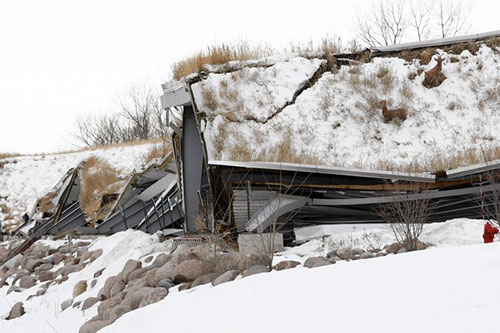
A little over a month ago, the largest sloped green roof in North America collapsed. There has been speculation as to why this roof collapsed, but no firm conclusions have been made as the investigation continues. The president of Aquascape, commented on the incident in a press release saying that the snow had melted on the roof but could not drain because of ice blocking the drainage system. It has been further explained that the sequence of unordinary weather conditions involving almost two feet of snow, freezing temps at night and 40 degree weather the next day, had allowed the circumstance to occur.
While this seems like a likely explanation reinforced by weather data on the corresponding days, I cannot come to agreement with this theory. As an Architectural Engineering student, I find it hard to believe that not enough safety factors had been built into the structural design of this roof that even if the loads involved were applied, the structure would not fail. And while green roofs are a newly implemented technology in commercial construction in the United States, I do not think that the engineers handled the calculations incorrectly. Designing with green roof loads is not very difficult as dead loads (green roof system?s components, thickness of soil, and vegetation per square foot) are fairly uniform. In addition, the live loads (snow, ice, and maximum water retention of the soil are also uniform and would be designed for peak load simultaneously using even safety factors over 50%. For this reason the behavior of a green roof and loads applied are known and will be, in essence, over-engineered by code to avoid this type of failure.
Keeping all of this in mind, what else could have caused this collapse if the beam sizes and connections were designed appropriately?
This is the type of question that has construction managers and contractors shaking in their work boots. As new sustainable technology is implemented into large construction projects there is a lot of room for error. Rarely, are these failures a result of poor technology, but a lack of compliance to specified installation instructions. Contractors unfamiliar with this new construction tend to make mistakes that get covered up until forensic investigations uncover them after tragic events.
Incidents such as the Aquascape green roof collapse should not discourage people from using sustainable products and technologies in new buildings but should emphasize the need for construction managers and contractors that are familiar with the new technology. It will be interesting to see what the forensic investigation concludes.
A little over a month ago, the largest sloped green roof in North America collapsed. There has been speculation as to why this roof collapsed, but no firm conclusions have been made as the investigation continues. The president of Aquascape, commented on the incident in a press release saying that the snow had melted on the roof but could not drain because of ice blocking the drainage system. It has been further explained that the sequence of unordinary weather conditions involving almost two feet of snow, freezing temps at night and 40 degree weather the next day, had allowed the circumstance to occur.
While this seems like a likely explanation reinforced by weather data on the corresponding days, I cannot come to agreement with this theory. As an Architectural Engineering student, I find it hard to believe that not enough safety factors had been built into the structural design of this roof that even if the loads involved were applied, the structure would not fail. And while green roofs are a newly implemented technology in commercial construction in the United States, I do not think that the engineers handled the calculations incorrectly. Designing with green roof loads is not very difficult as dead loads (green roof system?s components, thickness of soil, and vegetation per square foot) are fairly uniform. In addition, the live loads (snow, ice, and maximum water retention of the soil are also uniform and would be designed for peak load simultaneously using even safety factors over 50%. For this reason the behavior of a green roof and loads applied are known and will be, in essence, over-engineered by code to avoid this type of failure.
Keeping all of this in mind, what else could have caused this collapse if the beam sizes and connections were designed appropriately?
This is the type of question that has construction managers and contractors shaking in their work boots. As new sustainable technology is implemented into large construction projects there is a lot of room for error. Rarely, are these failures a result of poor technology, but a lack of compliance to specified installation instructions. Contractors unfamiliar with this new construction tend to make mistakes that get covered up until forensic investigations uncover them after tragic events.
Incidents such as the Aquascape green roof collapse should not discourage people from using sustainable products and technologies in new buildings but should emphasize the need for construction managers and contractors that are familiar with the new technology. It will be interesting to see what the forensic investigation concludes.
Source: http://www.sustainableconstructionblog.com/news/aquascape-green-roof-failure
electrician in Columbia VA Columbia electrician electrician Columbia electrician in Columbia electrician Columbia VA
Relying on a Contracting Officer's Advice Could Cost You Your Contract
By: Edward T. DeLisle & Maria L. Panichelli
Be careful what you ask for, or, in the context of federal government contracting, be careful how you ask and how the government responds. If you're not careful, you may get what you ask for, but lose a contract. That's the lesson learned in NCI Information Systems, Inc.
In NCI Information Systems, Inc., the Department of Defense, U.S. Transportation Command (“USTRANSCOM”) issued an RFP, seeking IT administrative and management support services. The RFP incorporated FAR § 52.215-1(c)(3)(i), which states that if no time is specified in the solicitation, the deadline for receipt is 4:30 p.m., local time on the date identified.
Following the initial submittal of proposals, discussions ensued. After three rounds of discussions, the agency requested that those companies remaining in contention for award submit final proposal revisions “by close of business on 31 August 2011.” It did not specify what time constituted “close of business.” The agency’s failure to specify a time created some confusion, because USTRANSCOM employees work flextime schedules, with different hours on different days. Because of this, its office would "close" at different times on different days.
Knowing this, on August 31, at 4:21 p.m., Harris IT Services (“Harris”), one of the prospective contractors, sent an e-mail to the Contracting Officer, asking whether the government would extend “close of business” until after 4:30 PM CST. The Contracting Officer responded to Harris stating: “[u]ntil 5:00 PM Central Time is acceptable as meeting the close of business deadline.” Harris’ final proposal revisions reached the agency’s central server at 4:57 p.m. CST and arrived at the Contracting Officer’s computer at 4:59 p.m. CST on August 31. Harris was ultimately awarded the contract.
Thereafter, a protest was initiated by a competitor, NCI Information Systems, Inc., which claimed that Harris was ineligible for award because its final proposal revisions were untimely. Specifically, NCI argued that the agency set the due date for Final proposal revisions as the close of business on August 31, and that because the Contracting Officer’s notice did not provide a specific time, the time for receipt of FPRs was 4:30 p.m. pursuant to FAR § 52.215-1(c)(3)(i). The GAO agreed.
Though Harris argued that “close of business” should be interpreted as “any time prior to when the office closed for the day . . . so long as an employee remained in the office during that employee’s regularly scheduled duty hours,” the GAO declined to adopt such a rule. It reasoned that “[a]doption of such a rule would result in confusion and a lack of uniformity." Instead, the GAO held that where an agency, such as USTRANSCOM, lacks official working hours, FAR § 52.215-1(c)(3)(i) will govern, and 4:30 p.m. local time will be considered to be the close of business. The GAO was not persuaded by Harris’ argument concerning the Contracting Officer’s extension of the time for submission, concluding that “an offeror acts unreasonably when it relies on the informal advice of a contracting officer rather than following the solicitation’s instructions.” Accordingly, the protest was sustained, and Harris was divested of its contract.
The lesson is not to rely on informal advice from a Contracting Officer, even if it is in writing. If the advice you receive was not given to all potential bidders, or incorporated into a formal modification of some kind, the terms of the most recent instructions provided to all will govern, despite what the Contracting Officer told you.
Edward T. DeLisle is a Partner in the firm and a member of the Federal Contracting Practice Group. Maria L. Panichelli is an Associate in the firm’s Federal Practice Group.
Source: http://feeds.lexblog.com/~r/FederalConstructionContractingBlog/~3/QtFqpHTiHbs/
Columbia electrician electrician Columbia electrician in Columbia electrician Columbia VA electrician in Columbia VA
Top 5 Sustainable Construction Blog Articles
--Happy Birthday to the Sustainable Construction Blog!
After one year of blogging the Sustainable Construction Blog has published many articles covering many technologies, products, projects, and issues in the sustainable construction industry. We have received a great deal of feedback in the News, Construction and Renovations blogs and look forward to more discussion and input in the next year, as more content covering the most popular trends and topics is published.
This past year, the Sustainable Construction Blog was proud to partner with ZamRay.com; a cutting edge website designed to assist the sustainability of the construction industry. We are also proud to advocate Philadelphia University?s live radio show, Ecoman and the Skeptic, as they just got their third season underway!
Again, thank you for your continued support. Below is a list of the 5 most popular articles since the launch of the Sustainable Construction Blog.
Passive House vs LEED Standards
The Role of Steel in Sustainable Prefabricated Buildings
Sustainable Kitchen Inspiration and Ideas
Recycled Aggregate for Carbon Neutral Concrete
BIM Software for Sustainability
The Role of Steel in Sustainable Prefabricated Buildings
Sustainable Kitchen Inspiration and Ideas
Recycled Aggregate for Carbon Neutral Concrete
BIM Software for Sustainability
Source: http://www.sustainableconstructionblog.com/news/top-5-sustainable-construction-blog-articles
electrician Columbia electrician in Columbia electrician Columbia VA electrician in Columbia VA Columbia electrician
Friday, June 29, 2012
London provides the first sustainable Olympics ...and more

Being the host of the Summer Olympic Games is a privilege and an opportunity for a city and a nation to spark economic growth. London, the host of the 2012 Olympic Games, plans to do more than just that. The London Organizing Committee of the Olympic Games is a company that is in charge of handling private sector investments and public sector funding. The public funding is provided by the Department for Culture, Media and Sport. They are using this opportunity to develop a struggling part of London into a sustainable community that will thrive off of the new infrastructure developed around Olympic Park for many years to come. Accordingly, the focus of all planning and construction is on the ?legacy? of the Olympic Games in East London.
Based on England?s grasp of sustainability, I expect the new Olympic venues to harness some of the most sustainable qualities and innovations available. Further than using new ?green? materials and technologies, the concepts behind the planning and future of the Olympic sites make it a wholesome sustainable project. The underlying sustainable mentality was based on reusing existing venues when possible, creating permanent structures only where they will be kept for long-term use, and using temporary structures for anything that will be taken down after the games.
In general, the sustainability plan focuses on climate change, biodiversity, waste, inclusion of local community, and healthy living. All of these aspects are considered when designing and planning. It is exciting to learn about all of the new projects and the sustainable development of such a large area and population. The Sustainable Construction Blog will share many posts including details of the construction project and analysis of how London is implementing the sustainability plan into these projects.
The results of this project should provide inspiration to the rest of the world as a model of sustainability.
electrician Columbia VA electrician in Columbia VA Columbia electrician electrician Columbia electrician in Columbia
A Year at a Glance - the WOSB Program
By: Edward T. DeLisle & Maria L. Panichelli
Last year, after over a decade of discussion, the Small Business Administration (SBA) finally implemented a federal contracting program specifically designed to assist small businesses owned by women. This program authorizes contracting officers to set aside federal contracts for eligible WOSBs (woman-owned small businesses) and EDWOSBs (economically disadvantaged women-owned small businesses). As we previously discussed, this program became officially effective on February 4, 2011 and was scheduled for gradual implementation over a period of months. It was expected to assist federal agencies in achieving the previously existing statutory procurement goal of awarding five percent (5%) of federal contracting dollars to WOSBs.
A year after going into affect, it is clear that the program is off to a slow start. Only about 10,000 WOSBs have been self-certified via the WOSB Program Repository, though there are certainly many more businesses out there that meet the eligibility criteria. If you are one of those businesses, you could be missing out on huge opportunities. As such, it is important for you to determine whether you meet the eligibility criteria for participation in the program.
What are those criteria, you ask? As a threshold matter, the business must be considered “small” in its primary industry in accordance with SBA’s size standards for that industry. In addition, to be considered an eligible WOSB or EDWOSB, a firm must be at least 51% owned and controlled by one or more women, or economically disadvantaged women. 13 C.F.R. 127.200. “Ownership” must be direct; it cannot be through an affiliate or association with others. 13 C.F.R. 127.201. The SBA defines "control" as a situation where the business owner has long-term decision-making and the day-to-day, full-time management and administration responsibilities for business operations. 13 C.F.R. 127.202.
In order to avoid abuse of the program by companies not truly owned and controlled by women, the SBA has enacted additional safeguards. Specifically, the woman owners must have managerial experience of the extent and complexity needed to run the company. The woman manager need not have the technical expertise or possess a required license (if applicable), if she can demonstrate that she has ultimate managerial and supervisory control over those who possess the required licenses or technical expertise. However, the SBA has stated that if a man possesses the required license and has an equity interest in the firm, he may be found to control the concern. 13 C.F.R. 127.202.
For those businesses that meet the requirements above, the WOSB and EDWOSB programs offer huge advantages. Five percent of all federal spending is the procurement goal for WOSB/EDWOSBs, and there is also a five percent subcontracting goal to WOSBs. With only about 10,000 businesses out there registered to compete, your chances of securing a government contract are vastly improved if you and eligible and participate in the program. In addition, there is no term limit to the WOSB and EDWOSB programs, and mentor-protégé programs are available.
In short, if you meet the program requirements, you should get registered for participation in the program as soon as possible. In the alternative, if you are thinking of starting a business that might be eligible, don’t wait! The SBA has not set forth a minimum amount of time the firm must be in business; therefore, a woman may establish a business, meet the requirements, self-certify, and win a government contract under this program in a short period of time.
Once you have determined that your business is eligible, registration in the program is rather easy. First, in preparation for registration/certification, businesses should become familiar with the WOSB Program’s Compliance Guide. The next step is to register the business in the Central Contracting Registry (CCR) or in the System for Award Management (SAM) (the government’s new registration system previously discussed here), once it is implemented. Then, log onto the SBA’s General Login System (GLS), and access the WOSB Program repository. Upload/categorize all required documents (a complete list of required documents can be found in the WOSB Program’s Compliance Guide). Then, complete the applicable certification form(s) available on the SBA website and register the business’s status as either a WOSB or EDWOSB, through either the Online Representations and Certifications Application (ORCA), or SAM. Lastly, get out there and start bidding!
Edward T. DeLisle is a Partner in the firm and a member of the Federal Contracting Practice Group. Maria L. Panichelli is an Associate in the firm’s Federal Practice Group.
Source: http://feeds.lexblog.com/~r/FederalConstructionContractingBlog/~3/AlNBbpMDbFc/
Columbia electrician electrician Columbia electrician in Columbia electrician Columbia VA electrician in Columbia VA
A Sustainable Construction Outlook for 2011
2011 buzzwords: net-zero energy, passive house, and photovoltaic.
As we bring in the New Year, there are several trends that will define the construction industry in 2011. As in recent years, the industry is undoubtedly headed in a sustainable direction focusing on environmentally friendly materials, energy efficiency, and alternative energy sources. The outlook for the industry in 2011 considers these same principles, but we will see a stronger more informed focus in several areas.
Achieving net-zero energy has become the driving force behind many sustainable projects both commercially and residentially. Net-zero energy is a term that defines the outcome of a buildings performance due to its energy efficiency based on super-insulation properties combined with alternative energy sources.
Sustainable construction developments over the past few years have brought us new innovations and technologies that have prepared the industry to take a more feasible approach to redefining building standards. While the USGBC?s LEED certification standards have been a strong notion to spark the green building revolution, they have also faced a fair share of adversity in 2010. Adopting energy efficiency and alternative energy guidelines from the LEED standards, and then taking these standards one step higher, leaves us with a new industry wide focus that becomes more budget friendly in an otherwise economically suffering industry.
Since net-zero energy is merely a concept; it fundamentally defines an achievable goal that allows architects and engineers to decide how this goal will be reached without being bound by a scorecard of standards. One set of standards that can be used as a general guideline for super insulation is Passive House. The Passive House standards are not as complex or demanding as LEED but provide a more beneficial result; one which is crucial in achieving net-zero energy. Its main goal is to decrease energy loads in the building and meet the new alternative energy technologies halfway for a net-zero energy building performance.
Looking back on 2010, this outlook can be justified by recalling what the majority of investment and research activity focused on. The U.S. government, under the American Recovery and Reinvestment Act (ARRA projects), invested in energy reducing electrical and mechanical systems, window and wall insulation research and development, and many photovoltaic products and projects. As ARRA funding runs out this year, the construction of new bridges and highways will slow down; however, residential and commercial projects are expected to increase. It will be an exciting year for the construction industry to see these new technologies implemented into state of the art, net-zero projects that will set a new precedent for years to come.
As we bring in the New Year, there are several trends that will define the construction industry in 2011. As in recent years, the industry is undoubtedly headed in a sustainable direction focusing on environmentally friendly materials, energy efficiency, and alternative energy sources. The outlook for the industry in 2011 considers these same principles, but we will see a stronger more informed focus in several areas.
Achieving net-zero energy has become the driving force behind many sustainable projects both commercially and residentially. Net-zero energy is a term that defines the outcome of a buildings performance due to its energy efficiency based on super-insulation properties combined with alternative energy sources.
Sustainable construction developments over the past few years have brought us new innovations and technologies that have prepared the industry to take a more feasible approach to redefining building standards. While the USGBC?s LEED certification standards have been a strong notion to spark the green building revolution, they have also faced a fair share of adversity in 2010. Adopting energy efficiency and alternative energy guidelines from the LEED standards, and then taking these standards one step higher, leaves us with a new industry wide focus that becomes more budget friendly in an otherwise economically suffering industry.
Since net-zero energy is merely a concept; it fundamentally defines an achievable goal that allows architects and engineers to decide how this goal will be reached without being bound by a scorecard of standards. One set of standards that can be used as a general guideline for super insulation is Passive House. The Passive House standards are not as complex or demanding as LEED but provide a more beneficial result; one which is crucial in achieving net-zero energy. Its main goal is to decrease energy loads in the building and meet the new alternative energy technologies halfway for a net-zero energy building performance.
Looking back on 2010, this outlook can be justified by recalling what the majority of investment and research activity focused on. The U.S. government, under the American Recovery and Reinvestment Act (ARRA projects), invested in energy reducing electrical and mechanical systems, window and wall insulation research and development, and many photovoltaic products and projects. As ARRA funding runs out this year, the construction of new bridges and highways will slow down; however, residential and commercial projects are expected to increase. It will be an exciting year for the construction industry to see these new technologies implemented into state of the art, net-zero projects that will set a new precedent for years to come.
Source: http://www.sustainableconstructionblog.com/construction/a-sustainable-construction-outlook-for-2011
electrician Columbia electrician in Columbia electrician Columbia VA electrician in Columbia VA Columbia electrician
Supermajority Requirements Render Business Concern Ineligible for Participation in the SDVO Program
By: Edward T. DeLisle & Maria L. Panichelli
SDVOSB Appeal of Rush-Link One Joint Venture, SBA No. VET-228 (2012), a recent Small Business Administration Office of Hearings and Appeals (“OHA”) decision that we discussed previously, demonstrates how a company’s internal corporate structure can impact that company’s eligibility to participate in the Service-Disabled Veteran Owned (“SDVO”) small business program.
SDVOSB Appeal of Rush-Link One concerned a joint-venture, Rush-Link One, which was 51%-owned by Link Contracting, Inc. (Link), a purported SDVO small business concern. Mr. George Carpenter, a service-disabled veteran, owned 55% of Link. Following the award of a SDVOSB set-aside contract to Rush-Link One, a competitor challenged the joint-venture’s eligibility for the SDVO program.
Pursuant to 13 C.F.R. § 125.10(a), a small business concern may qualify as an eligible SDVO only if the management and daily business operations of that concern are “controlled” by one or more service-disabled veterans. The regulations define “control” differently, depending upon the type of corporate structure employed. In the case of a partnership, one or more service-disabled veterans must serve as general partners, with control over all partnership decisions. 13 C.F.R. § 125.10(c). A limited liability company (LLC) is “controlled” by a service-disabled veteran only if one or more service-disabled veterans serve as managing members, with control over all decisions of the LLC. 13 C.F.R. § 125.10(d). In the case of a corporation, such as Link, the service-disabled veteran must prove that he or she has “control” over the corporation’s Board of Directors, thereby allowing him or her to make all major decisions on the company’s behalf. 13 C.F.R. § 125.10(e). Service-disabled veterans control the Board of Directors when either: (1) one or more service-disabled veterans own at least 51% of all voting stock of the concern, are on the Board of Directors and have the percentage of voting stock necessary to overcome any super majority voting requirements; or (2) service-disabled veterans comprise the majority of voting directors through actual numbers or, where permitted by state law, through weighted voting. 13 C.F.R. § 125.10(e).
Applying the above in Rush-Link One, the OHA concluded that the supermajority requirements in Link’s shareholders’ agreement abrogated the service-disabled veteran owner’s “control” of the corporation under 13 C.F.R. § 125.10, and rendered the concern and, therefore, the joint-venture, ineligible for participation in the SDVOSB program. The OHA found that, although Link was 55% owned by a service-disabled veteran, its shareholders executed a formal shareholders' agreement which stated that “[e]xcept as otherwise provided herein or in [Link’s] bylaws, all decisions of the Shareholders shall be made by a majority vote. “Majority vote” was defined as one in which “seventy percent (70%) of the issued shares of the Corporation vote to pass the issue or matter.” The same paragraph of the shareholders' agreement indicated that “[t]his provision shall supersede any contrary provision of [Link’s] bylaws or Articles of Incorporation (as they stand now or may subsequently be amended).” Accordingly, the OHA found that Mr. Carpenter’s 55% ownership of Link was insufficient to overcome the supermajority requirement set forth in the shareholders’ agreement, and, consequently, that he did not “control” Link’s board of directors or Link as a whole. Therefore, OHA concluded that Link was not a SDVOSB, and that Rush-Link one was not an eligible SDVOSB joint-venture.
Let this case serve as a reminder that internal corporate governance is critically important to SDVOSB eligibility. In our practice, it represents the single, most frequently cited basis for the loss or denial of SDVOSB status.
Edward T. DeLisle is a Partner in the firm and a member of the Federal Contracting Practice Group. Maria L. Panichelli is an Associate in the firm’s Federal Practice Group.
Source: http://feeds.lexblog.com/~r/FederalConstructionContractingBlog/~3/KL5W9pFwrAE/
Columbia electrician electrician Columbia electrician in Columbia electrician Columbia VA electrician in Columbia VA
How R-Values are Measured
In sustainable construction, one of the most proven and sought after energy reducing techniques is superinsulating in new construction or retrofitting an old building with more efficient or additional insulation. When installed correctly, insulation is very effective in reducing energy loads on HVAC systems by keeping a more regulated and constant indoor temperature. There are many types of insulation ranging from spray foam, to loose-fill batt, to rigid EPS, and choosing which one to use can be based on many factors. However, the R-value of insulation takes precedent over all other factors when choosing insulation.
An R-value is defined as a measure of a material?s ability to resist heat transfer.
Because consumers buy insulation based on its R-value, companies who manufacture insulation must have the R-value of their product regulated by ASTM standards. While several technical standards have been written due to specific applications of what materials are tested, a general process is common in all ASTM tests.
The Oak Ridge National Laboratory has state of the art technologies for testing insulation and has been conducting R-value testing for over two decades. All of their tests are now done using a hot box apparatus. On a large scale, a hot box apparatus can fit entire mock-up wall sections into its clam shell-like chamber. After running a test, an average rating per square foot can be assigned to any given wall section. A Rotatable Guarded Hot Box has the ability to provide the thermal conductivity measurement in a vertical or horizontal application or any angle in between that a pitched roof may be. On a smaller scale a hotbox apparatus can be built to test the R-value over a given square foot of insulation or sheathing material.
How a Hotbox Apparatus Works
Two clam shell chambers hold the material to be tested in an airtight and locked position. This creates two climate chambers, one on each side of the material, which can be regulated to steady-state conditions. One side is designated as the metering (hot) chamber, while the other is the climate (cold) chamber. Air is sent into each chamber and regulated by velocity and temperature of the air at the source. The air is blown parallel to the surface of the material to prevent any convection that could occur. Once the hot and cold side has reached a steady state the temperature of the material is measured on each side and the test begins. The average temperature is recorded on each side of the material until the temperatures and heat flows are equilibrated. Using the data collected the R-value is calculated using energy output of heating and cooling components, the energy exchange between the two chambers, the area of the chamber and average surface temperatures on each side. The formula for R-value is, R= A[t1-t2]/(Qk +Qf + Qmb). At Oak Ridge National Library, arriving at a final R-value means that two successive four hour tests have produced values within 1% of variance.
Source: Oak Ridge National Laboratory
An R-value is defined as a measure of a material?s ability to resist heat transfer.
Because consumers buy insulation based on its R-value, companies who manufacture insulation must have the R-value of their product regulated by ASTM standards. While several technical standards have been written due to specific applications of what materials are tested, a general process is common in all ASTM tests.
The Oak Ridge National Laboratory has state of the art technologies for testing insulation and has been conducting R-value testing for over two decades. All of their tests are now done using a hot box apparatus. On a large scale, a hot box apparatus can fit entire mock-up wall sections into its clam shell-like chamber. After running a test, an average rating per square foot can be assigned to any given wall section. A Rotatable Guarded Hot Box has the ability to provide the thermal conductivity measurement in a vertical or horizontal application or any angle in between that a pitched roof may be. On a smaller scale a hotbox apparatus can be built to test the R-value over a given square foot of insulation or sheathing material.
How a Hotbox Apparatus Works
Two clam shell chambers hold the material to be tested in an airtight and locked position. This creates two climate chambers, one on each side of the material, which can be regulated to steady-state conditions. One side is designated as the metering (hot) chamber, while the other is the climate (cold) chamber. Air is sent into each chamber and regulated by velocity and temperature of the air at the source. The air is blown parallel to the surface of the material to prevent any convection that could occur. Once the hot and cold side has reached a steady state the temperature of the material is measured on each side and the test begins. The average temperature is recorded on each side of the material until the temperatures and heat flows are equilibrated. Using the data collected the R-value is calculated using energy output of heating and cooling components, the energy exchange between the two chambers, the area of the chamber and average surface temperatures on each side. The formula for R-value is, R= A[t1-t2]/(Qk +Qf + Qmb). At Oak Ridge National Library, arriving at a final R-value means that two successive four hour tests have produced values within 1% of variance.
Source: Oak Ridge National Laboratory
Source: http://www.sustainableconstructionblog.com/construction/how-r-values-are-measured
electrician in Columbia VA Columbia electrician electrician Columbia electrician in Columbia electrician Columbia VA
Thursday, June 28, 2012
Practical Marketing Considerations for Construction Brands FREE Webcast
Practical Marketing Considerations for Construction Brands Free Webcast – Tuesday, May 15, 2012 A webcast from the Construction Marketing Association (CMA) will address the three very important aspects of marketing in the construction industry:� hiring marketing talent, selecting marketing partners, and improving teamwork between marketing and sales departments. The free webcast for members and non-members [...]
electrician in Columbia VA Columbia electrician electrician Columbia electrician in Columbia electrician Columbia VA
Sheldon Crossing: A luxurious sustainable community
For those who don?t know, Manayunk is a unique urban neighborhood just outside of Philadelphia. Main St., along the Schuylkill River is a popular area that is home to many high end restaurants and shopping. When I heard about a green community in Manayunk I had to check it out.
At first instinct I kind of chuckled to myself; wondering how anyone could actually make a successful sustainable community in Manayunk and actually sell the properties. After touring a model home I learned that the starting price for an unfurnished 3 bedroom/2 bath rowhome is 700k dollars. One can easily make the assumption that the ?green? aspect of this carriage-home community is merely a marketing scheme to support the outrageous price tag. I thought maybe this was the case, but in fact I have to applaud their efforts to build responsibly and efficiently because given the building site and existing circumstances, I feel they did a fairly decent job. After all they are trying to obtain LEED platinum certification.
More importantly as a sustainable community, I would like to see this development offer a sustainable lifestyle to the people that live in it. At most, they chose materials that are responsible, partial sustainable utilities, and offer amenities such as an electric car charger in your garage. Utilizing icynene for insulation and structral insulated sheathing, these homes are efficient considering they are stick built.
Alternative energy sources were limited due to the infrastructure of the area. Photovoltaics on the roof help to heat the water and supply partial power. Overall, Sheldon Crossing claims 75% energy savings in their homes. This helps to justify part of the initial investment in a 700k dollar home. The other half of the justification is implied in the ?luxury? aspect of their advertisements. They really are nice, and do provide a luxurious, unique interior that is eco-friendly. The real downfall of the community is its location. It?s on a hill with great ?green roof? top views of the city, but don?t look down across the street. It?s just not a luxurious area, and I?m not a real estate expert but comparable sized homes in the neighborhood can?t be more than 300k.
They are great looking green homes that offer luxury in a not so luxurious area. Some of the sustainable features that are truly unique to Manayunk are the green roofs with photovoltaic panels. Regardless of minor issues implied with having these properties in a not so sustainable and luxurious area, I am excited to see sustainable projects developed locally.
visit Sheldon Crossing here
Source: http://www.sustainableconstructionblog.com/news/sheldon-crossing-a-luxurious-sustainable-community
electrician Columbia VA electrician in Columbia VA Columbia electrician electrician Columbia electrician in Columbia
Supermajority Requirements Render Business Concern Ineligible for Participation in the SDVO Program
By: Edward T. DeLisle & Maria L. Panichelli
SDVOSB Appeal of Rush-Link One Joint Venture, SBA No. VET-228 (2012), a recent Small Business Administration Office of Hearings and Appeals (“OHA”) decision that we discussed previously, demonstrates how a company’s internal corporate structure can impact that company’s eligibility to participate in the Service-Disabled Veteran Owned (“SDVO”) small business program.
SDVOSB Appeal of Rush-Link One concerned a joint-venture, Rush-Link One, which was 51%-owned by Link Contracting, Inc. (Link), a purported SDVO small business concern. Mr. George Carpenter, a service-disabled veteran, owned 55% of Link. Following the award of a SDVOSB set-aside contract to Rush-Link One, a competitor challenged the joint-venture’s eligibility for the SDVO program.
Pursuant to 13 C.F.R. § 125.10(a), a small business concern may qualify as an eligible SDVO only if the management and daily business operations of that concern are “controlled” by one or more service-disabled veterans. The regulations define “control” differently, depending upon the type of corporate structure employed. In the case of a partnership, one or more service-disabled veterans must serve as general partners, with control over all partnership decisions. 13 C.F.R. § 125.10(c). A limited liability company (LLC) is “controlled” by a service-disabled veteran only if one or more service-disabled veterans serve as managing members, with control over all decisions of the LLC. 13 C.F.R. § 125.10(d). In the case of a corporation, such as Link, the service-disabled veteran must prove that he or she has “control” over the corporation’s Board of Directors, thereby allowing him or her to make all major decisions on the company’s behalf. 13 C.F.R. § 125.10(e). Service-disabled veterans control the Board of Directors when either: (1) one or more service-disabled veterans own at least 51% of all voting stock of the concern, are on the Board of Directors and have the percentage of voting stock necessary to overcome any super majority voting requirements; or (2) service-disabled veterans comprise the majority of voting directors through actual numbers or, where permitted by state law, through weighted voting. 13 C.F.R. § 125.10(e).
Applying the above in Rush-Link One, the OHA concluded that the supermajority requirements in Link’s shareholders’ agreement abrogated the service-disabled veteran owner’s “control” of the corporation under 13 C.F.R. § 125.10, and rendered the concern and, therefore, the joint-venture, ineligible for participation in the SDVOSB program. The OHA found that, although Link was 55% owned by a service-disabled veteran, its shareholders executed a formal shareholders' agreement which stated that “[e]xcept as otherwise provided herein or in [Link’s] bylaws, all decisions of the Shareholders shall be made by a majority vote. “Majority vote” was defined as one in which “seventy percent (70%) of the issued shares of the Corporation vote to pass the issue or matter.” The same paragraph of the shareholders' agreement indicated that “[t]his provision shall supersede any contrary provision of [Link’s] bylaws or Articles of Incorporation (as they stand now or may subsequently be amended).” Accordingly, the OHA found that Mr. Carpenter’s 55% ownership of Link was insufficient to overcome the supermajority requirement set forth in the shareholders’ agreement, and, consequently, that he did not “control” Link’s board of directors or Link as a whole. Therefore, OHA concluded that Link was not a SDVOSB, and that Rush-Link one was not an eligible SDVOSB joint-venture.
Let this case serve as a reminder that internal corporate governance is critically important to SDVOSB eligibility. In our practice, it represents the single, most frequently cited basis for the loss or denial of SDVOSB status.
Edward T. DeLisle is a Partner in the firm and a member of the Federal Contracting Practice Group. Maria L. Panichelli is an Associate in the firm’s Federal Practice Group.
Source: http://feeds.lexblog.com/~r/FederalConstructionContractingBlog/~3/KL5W9pFwrAE/
electrician in Columbia electrician Columbia VA electrician in Columbia VA Columbia electrician electrician Columbia
Relying on a Contracting Officer's Advice Could Cost You Your Contract
By: Edward T. DeLisle & Maria L. Panichelli
Be careful what you ask for, or, in the context of federal government contracting, be careful how you ask and how the government responds. If you're not careful, you may get what you ask for, but lose a contract. That's the lesson learned in NCI Information Systems, Inc.
In NCI Information Systems, Inc., the Department of Defense, U.S. Transportation Command (“USTRANSCOM”) issued an RFP, seeking IT administrative and management support services. The RFP incorporated FAR § 52.215-1(c)(3)(i), which states that if no time is specified in the solicitation, the deadline for receipt is 4:30 p.m., local time on the date identified.
Following the initial submittal of proposals, discussions ensued. After three rounds of discussions, the agency requested that those companies remaining in contention for award submit final proposal revisions “by close of business on 31 August 2011.” It did not specify what time constituted “close of business.” The agency’s failure to specify a time created some confusion, because USTRANSCOM employees work flextime schedules, with different hours on different days. Because of this, its office would "close" at different times on different days.
Knowing this, on August 31, at 4:21 p.m., Harris IT Services (“Harris”), one of the prospective contractors, sent an e-mail to the Contracting Officer, asking whether the government would extend “close of business” until after 4:30 PM CST. The Contracting Officer responded to Harris stating: “[u]ntil 5:00 PM Central Time is acceptable as meeting the close of business deadline.” Harris’ final proposal revisions reached the agency’s central server at 4:57 p.m. CST and arrived at the Contracting Officer’s computer at 4:59 p.m. CST on August 31. Harris was ultimately awarded the contract.
Thereafter, a protest was initiated by a competitor, NCI Information Systems, Inc., which claimed that Harris was ineligible for award because its final proposal revisions were untimely. Specifically, NCI argued that the agency set the due date for Final proposal revisions as the close of business on August 31, and that because the Contracting Officer’s notice did not provide a specific time, the time for receipt of FPRs was 4:30 p.m. pursuant to FAR § 52.215-1(c)(3)(i). The GAO agreed.
Though Harris argued that “close of business” should be interpreted as “any time prior to when the office closed for the day . . . so long as an employee remained in the office during that employee’s regularly scheduled duty hours,” the GAO declined to adopt such a rule. It reasoned that “[a]doption of such a rule would result in confusion and a lack of uniformity." Instead, the GAO held that where an agency, such as USTRANSCOM, lacks official working hours, FAR § 52.215-1(c)(3)(i) will govern, and 4:30 p.m. local time will be considered to be the close of business. The GAO was not persuaded by Harris’ argument concerning the Contracting Officer’s extension of the time for submission, concluding that “an offeror acts unreasonably when it relies on the informal advice of a contracting officer rather than following the solicitation’s instructions.” Accordingly, the protest was sustained, and Harris was divested of its contract.
The lesson is not to rely on informal advice from a Contracting Officer, even if it is in writing. If the advice you receive was not given to all potential bidders, or incorporated into a formal modification of some kind, the terms of the most recent instructions provided to all will govern, despite what the Contracting Officer told you.
Edward T. DeLisle is a Partner in the firm and a member of the Federal Contracting Practice Group. Maria L. Panichelli is an Associate in the firm’s Federal Practice Group.
Source: http://feeds.lexblog.com/~r/FederalConstructionContractingBlog/~3/QtFqpHTiHbs/
electrician in Columbia VA Columbia electrician electrician Columbia electrician in Columbia electrician Columbia VA
GAO Expands Its Jurisdiction to Consider All Task Order Protests
Prior to 2008, dating back to 1994, it was not permissible to protest a task order. The 1994 enactment of the Federal Acquisition Streamlining Act ("FASA") provided that protests over task or delivery orders were barred unless the protest alleged that the order increased the scope, period, or maximum value of the underlying contract through which the order was issued. That changed with the passage of the Defense Authorization Act of 2008 ("NDAA"), which contained an amendment that expanded the jurisdiction of the GAO to include protests of task or delivery orders valued in excess of $10 million. 41 U.S.C., Section 253j(e)(2). The NDAA also contained a sunset provision, which stated that the "subsection shall be in effect for three years." Section 253j(e)(3). The three year period expired on May 27, 2011. The question then arose as to whether the GAO could lawfully consider task and delivery order protests after May 27, 2011. That question was recently answered in the affirmative by the GAO.
In a protest filed by Technatomy Corporation, of Fairfax, Virginia, the protester argued that the agency unreasonably evaluated vendors' technical and cost quotations. The government argued that the protest should be dismissed because the GAO's jurisdiction had expired. In a decision issued on June 14, 2011, the GAO disagreed with the government and ruled that it now has jurisdiction to rule on all task and delivery order protests, regardless of their dollar value. The reasoning of the GAO was that the sunset provision which gave the GAO the authority to consider task and delivery protests in excess of $10 million (for three years) replaced the former statutory provision (1994 - “FASA”) that provided for only very limited task order review. The GAO concluded that when the three year period expired, its authority to consider task and delivery order protests did not simply revert to the pre-2008 jurisdictional level, but actually reverted back to the pre-1994 level.
In other words since the pre-2008 limitations were eliminated by the sunset provision in 2008, the only thing left is the pre-1994 jurisdiction under the Competition in Contracting Act which places no limitation on the GAO's authority to consider task and delivery order protests. The GAO will therefore accept jurisdiction of all protests involving task and delivery orders regardless of the dollar value. This also raises the interesting question of whether, based on the GAO’s decision in Technatomy Corporation, the Court of Federal Claims will now accept jurisdiction of task and delivery order protests, as well.
Michael H. Payne is the Chairman of the firm's Federal Practice Group and, together with other experienced members of the group, frequently advises contractors on federal contracting matters, including teaming arrangements, negotiated procurements, bid protests, claims, and appeals.
Source: http://feeds.lexblog.com/~r/FederalConstructionContractingBlog/~3/aMyzPcyhTwk/
electrician Columbia VA electrician in Columbia VA Columbia electrician electrician Columbia electrician in Columbia
Wednesday, June 27, 2012
VA's Ambiguous Solicitation Leads to Successful Protest
By: Edward T. DeLisle
Over the last several years, the scrutiny over federal small business programs has grown. That scrutiny has led to changes in policy and legislation designed to curb potential fraud in the procurement process. Because these changes have been implemented in such a short period of time, however, it is not unusual for the government to issue solicitations for small business set-aside contracts that are confusing, or even contradictory. In Commandeer Construction Company, Inc., B-405771, December 29, 2011, that is precisely what occurred resulting in a successful protest.
Commandeer Construction involved a solicitation that was set aside for Service-Disabled, Veteran-Owned Small Businesses (SDVOSBs), a program that has experienced much change in recent years. In 2006, the VA was given the authority to restrict competition to SDVOSBs as part of the Veterans Benefits, Health Care, and Information Act (the "Act"). 38 U.S.C. 8127(d). As the GAO explained in Commandeer Construction, pursuant to the Act, an SDVOSB set-aside contract may only be issued to entities listed in a database of veteran-owned small businesses maintained by the VA. The VA has chosen to use what it has termed its "Vendor Information Pages" ("VIP"), which can be found at www.vetbiz.gov, as its official listing of veteran-owned and service-disabled, veteran-owned concerns.
Subsequent to issuance of the Act, the VA issued VAAR 804.1102, which states that all VOSB and SDVOSB entities must be listed in its VIP database by January 1, 2012 in order to be eligible for set-aside contracts for such entities. By December 31, 2011, all VOSB and SDVOSB entities must not only be listed, but must also be "verified," in order to receive new contract awards under the Veteran's First program, a program operated exclusively by the VA. While firms were once permitted to self-certify their status as VOSBs and SDVOSBs, as part of Veterans Benefits Act of 2010, the VA instituted a more rigorous qualification process. Consistent with this new review procedure, which was designed to weed out fraud, the VA's "Center for Veterans Enterprise" ("CVE") was given the authority to render eligibility determinations for these programs. If a firm wished to obtain a set-aside contract as a VOSB or a SDVOSB entity, it would have to be verified by CVE.
In an effort to assist in the transition from a self-certifying system to one requiring government approval, the VA issued what it called its "Memorandum from VA Acting Associate Deputy Assistant Secretary for Procurement Policy, Systems Oversight and Accompanying Class Deviation from VA Acquisition Regulation" (the "Memorandum"). The Memorandum referenced what the VA described as a "class deviation." Based upon this class deviation, any "apparently successful offeror" that had not already been verified by CVE, could become verified on an expedited basis, and obtain an award of a VOSB or SDVOSB set-aside contract, provided CVE approved its status. Later, the VA clarified its position regarding who may qualify for a “class deviation,” taking the position that a company was not eligible for “either award or Fast Track Verification," unless it was visible in the VA’s VIP database. Commandeer Construction addressed the interplay between the class deviation identified in the Memorandum and the VA’s attempt to subsequently clarify what it meant.
In Commandeer Construction, the VA issued an IFB for a construction contract that was set aside for eligible SDVOSB firms. The solicitation stated that the award would be made to an SDVOSB firm that had “been verified for ownership and control and [was] so listed in the [VIP] database.” The IFB also included the “class deviation” language referenced above. What was not included as part of the IFB, however, was the Memorandum (and accompanying deviation), or the clarification made to the deviation, which was issued after the fact.
On August 8, 2011, the protesting party, Commandeer Construction, submitted an application to the CVE for approval as an SDVOSB. Thereafter, on August 30, 2011, Commandeer submitted its bid. As its bid was the lowest of those submitted, Commandeer was in line for an award. As it was not listed in the VIP database, however, the contract specialist for the VA intended to contact Commandeer for purposes of explaining the process of obtaining expedited verification.
Prior to contacting Commandeer, the VA contract specialist apparently learned of the clarification for the first time and discussed its meaning and significance with other VA officials. Based upon these discussions, the VA contract specialist decided that Commandeer was ineligible for award and informed it of such by letter dated August 31, 2011. At the time, CVE had not rendered a final decision on Commandeer’s SDVOSB eligibility.
Commandeer protested VA’s decision, taking the position that rejecting its bid was improper based upon the expedited review procedures outlined in the solicitation. The VA countered that the deviation clause, upon which Commandeer relied for potential eligibility, was never meant to apply to entities that were absent from the VIP database. According to the VA, the deviation clause was merely an effort to provide assistance to those firms that had already self-certified, but had not yet been CVE verified under the new review procedures. Commandeer Construction at 4.
The GAO based its decision on a strict reading of the solicitation. The deviation clause in the solicitation specifically stated that “the apparent successful offeror” would be given an opportunity to have its SDVOSB status reviewed on an expedited basis, if it was not “currently listed as verified” in the VIP database. While the VA may not have intended for the deviation to apply to firms not already listed in its VIP database, the GAO concluded that the solicitation itself did not provide that qualification. As such, Commandeer’s understanding that it could qualify for award pursuant to the expedited review procedure was reasonable. Based upon this finding, the GAO recommended that the VA complete its review of Commandeer’s verification documents and, if found to be eligible for SDVOSB status, award it the contract.
As the government continues to alter its approach in exercising control over small business programs, mistakes, such as those in Commandeer Contracting, will happen. Contractors must exercise care in reviewing and responding to any solicitation. If, during the course of the review process, an ambiguity is discovered, bring it to the attention of the contract specialist, contracting officer, or source selection authority immediately. Doing so will benefit all bidders and quite possibly prevent a pre-bid protest. For those ambiguities that are not readily detectible, and are only revealed at the time of contract award, be prepared to discuss your concerns with an attorney familiar with such issues right away, as a protest is likely your only source of recourse. For those participating in the government’s various small business programs, the fast-paced nature of regulatory change has opened these programs up to issues such as those presented in Commandeer Contracting. Bid and beware.
Edward T. DeLisle is a Partner in the firm and a member of the Federal Contracting Practice Group.
Source: http://feeds.lexblog.com/~r/FederalConstructionContractingBlog/~3/xUVsTlENcKc/
electrician Columbia electrician in Columbia electrician Columbia VA electrician in Columbia VA Columbia electrician
Developers Must Pay Prevailing Wages for Privately Financed Public Infrastructure
By Bram Hanono and Greg Woodard
California Labor Code sections 1720 et seq. (the Prevailing Wage Law) ("PWL") require employers (including developers and contractors) engaged in public works projects to pay the prevailing wage to their employees if the project is "paid for in whole or in part out of public funds." The Second Appellate District Court of Appeal recently ruled that private developers must pay prevailing wages for the construction of all public improvements in connection with a development project if public funds are used to finance any part of the public improvements, even if the remaining public improvements are paid for with private funds. The California Supreme Court declined to hear the developer's appeal. Therefore, developers and contractors could face increased project costs as a result of this case.
Background & Summary
In Azusa Land Partners v. Department of Industrial Relations, 191 Cal.App.4th 1 (2010), the developer proposed a master planned 500+ acre development that included up to 1,200 homes, 50,000 square feet of commercial, and public infrastructure and improvements. To obtain the City of Azusa's approval, the developer agreed to public infrastructure and improvement work, including construction of a public school and park, freight under-crossings, sanitation district facilities, and street, bridge, storm drain, sewer, water, utilities, park and landscaping improvements. The public improvements were to be funded by Mello-Roos bonds which were approved for indebtedness of up to $120 million to be incurred by the Community Facilities District ("CFD"). The developer was required to construct the public improvements even if the actual costs exceeded the amount of bond funds sold by the CFD for the improvements. The total cost of the public improvements was approximately $146 million but the CFD only sold $71 million in bonds, leaving the developer on the hook for the remaining $75 million.
A third party requested an inquiry into whether the entire project was a "public work" subject to the PWL. "Public works" is broadly defined by the PWL and includes work "paid for in whole or in part out of public funds." The Department of Industrial Relations (the "Department"), which was charged with the review, determined that even though the project was only partly funded with public funds, the entire project was nevertheless a public work and subject to the PWL. However, the Department also found prevailing wage did not have to be paid on the entire project because the project met an exemption in the PWL (Labor Code section 1720(c)(2)) that required prevailing wage only for those public infrastructure improvements in the project required as a condition of regulatory approval. Accordingly, the developer had to pay prevailing wage for all those public improvements even though some were in fact privately funded due to the shortfall in CFD funding. The developer appealed, but the Department upheld its initial determination, meaning prevailing wage had to be paid for all of the public improvements.
The developer filed a petition for writ of mandate in superior court and the trial court denied the petition. On appeal, the developer argued it should only be required to pay prevailing wage for the public improvements actually financed with the Mello-Roos bond proceeds and not for privately funded infrastructure improvements for which no bond proceeds were received – the developer was seeking a more narrow interpretation under section 1720(c)(2) of the PWL.
The Court of Appeal disagreed with the developer. First, the court held that under the PWL, the entire project was a "public work" because the project was funded in part through public funds. Second, the court held that under the PWL, the Mello-Roos bond proceeds constituted public funds. Finally, the court rejected the developer's argument that even if the project was subject to the PWL, it should only be required to pay prevailing wage for the public improvements that were built with Mello-Roos bonds, and not any public improvements constructed at private expense. Instead, the Court of Appeal agreed with the Department and the trial court, interpreting the PWL to apply to all public improvements, regardless of whether or not they were paid for with Mello-Roos bonds.
On March 2, 2011, the California Supreme Court declined to hear the developer's appeal. As a result, the developer will be required to pay prevailing wage on the entire $146 million cost for the project's public improvements, including the $75 million in public improvements which it privately financed.
Comment
Going forward, developers and contractors may be required to pay prevailing wage on the entire build-out of public improvements, even if the development is mostly privately financed and privately owned. This means each party should carefully determine in their development and construction contracts whether prevailing wage rules apply and which party will pay the increased costs.
Authored By:
Bram Hanono & Gregory E. Woodard
Source: http://feeds.lexblog.com/~r/ConstructionInfrastructureLawBlog/~3/PO8gCqFoawE/
electrician in Columbia VA Columbia electrician electrician Columbia electrician in Columbia electrician Columbia VA
Relying on a Contracting Officer's Advice Could Cost You Your Contract
By: Edward T. DeLisle & Maria L. Panichelli
Be careful what you ask for, or, in the context of federal government contracting, be careful how you ask and how the government responds. If you're not careful, you may get what you ask for, but lose a contract. That's the lesson learned in NCI Information Systems, Inc.
In NCI Information Systems, Inc., the Department of Defense, U.S. Transportation Command (“USTRANSCOM”) issued an RFP, seeking IT administrative and management support services. The RFP incorporated FAR § 52.215-1(c)(3)(i), which states that if no time is specified in the solicitation, the deadline for receipt is 4:30 p.m., local time on the date identified.
Following the initial submittal of proposals, discussions ensued. After three rounds of discussions, the agency requested that those companies remaining in contention for award submit final proposal revisions “by close of business on 31 August 2011.” It did not specify what time constituted “close of business.” The agency’s failure to specify a time created some confusion, because USTRANSCOM employees work flextime schedules, with different hours on different days. Because of this, its office would "close" at different times on different days.
Knowing this, on August 31, at 4:21 p.m., Harris IT Services (“Harris”), one of the prospective contractors, sent an e-mail to the Contracting Officer, asking whether the government would extend “close of business” until after 4:30 PM CST. The Contracting Officer responded to Harris stating: “[u]ntil 5:00 PM Central Time is acceptable as meeting the close of business deadline.” Harris’ final proposal revisions reached the agency’s central server at 4:57 p.m. CST and arrived at the Contracting Officer’s computer at 4:59 p.m. CST on August 31. Harris was ultimately awarded the contract.
Thereafter, a protest was initiated by a competitor, NCI Information Systems, Inc., which claimed that Harris was ineligible for award because its final proposal revisions were untimely. Specifically, NCI argued that the agency set the due date for Final proposal revisions as the close of business on August 31, and that because the Contracting Officer’s notice did not provide a specific time, the time for receipt of FPRs was 4:30 p.m. pursuant to FAR § 52.215-1(c)(3)(i). The GAO agreed.
Though Harris argued that “close of business” should be interpreted as “any time prior to when the office closed for the day . . . so long as an employee remained in the office during that employee’s regularly scheduled duty hours,” the GAO declined to adopt such a rule. It reasoned that “[a]doption of such a rule would result in confusion and a lack of uniformity." Instead, the GAO held that where an agency, such as USTRANSCOM, lacks official working hours, FAR § 52.215-1(c)(3)(i) will govern, and 4:30 p.m. local time will be considered to be the close of business. The GAO was not persuaded by Harris’ argument concerning the Contracting Officer’s extension of the time for submission, concluding that “an offeror acts unreasonably when it relies on the informal advice of a contracting officer rather than following the solicitation’s instructions.” Accordingly, the protest was sustained, and Harris was divested of its contract.
The lesson is not to rely on informal advice from a Contracting Officer, even if it is in writing. If the advice you receive was not given to all potential bidders, or incorporated into a formal modification of some kind, the terms of the most recent instructions provided to all will govern, despite what the Contracting Officer told you.
Edward T. DeLisle is a Partner in the firm and a member of the Federal Contracting Practice Group. Maria L. Panichelli is an Associate in the firm’s Federal Practice Group.
Source: http://feeds.lexblog.com/~r/FederalConstructionContractingBlog/~3/QtFqpHTiHbs/
electrician Columbia electrician in Columbia electrician Columbia VA electrician in Columbia VA Columbia electrician
Developers Must Pay Prevailing Wages for Privately Financed Public Infrastructure
By Bram Hanono and Greg Woodard
California Labor Code sections 1720 et seq. (the Prevailing Wage Law) ("PWL") require employers (including developers and contractors) engaged in public works projects to pay the prevailing wage to their employees if the project is "paid for in whole or in part out of public funds." The Second Appellate District Court of Appeal recently ruled that private developers must pay prevailing wages for the construction of all public improvements in connection with a development project if public funds are used to finance any part of the public improvements, even if the remaining public improvements are paid for with private funds. The California Supreme Court declined to hear the developer's appeal. Therefore, developers and contractors could face increased project costs as a result of this case.
Background & Summary
In Azusa Land Partners v. Department of Industrial Relations, 191 Cal.App.4th 1 (2010), the developer proposed a master planned 500+ acre development that included up to 1,200 homes, 50,000 square feet of commercial, and public infrastructure and improvements. To obtain the City of Azusa's approval, the developer agreed to public infrastructure and improvement work, including construction of a public school and park, freight under-crossings, sanitation district facilities, and street, bridge, storm drain, sewer, water, utilities, park and landscaping improvements. The public improvements were to be funded by Mello-Roos bonds which were approved for indebtedness of up to $120 million to be incurred by the Community Facilities District ("CFD"). The developer was required to construct the public improvements even if the actual costs exceeded the amount of bond funds sold by the CFD for the improvements. The total cost of the public improvements was approximately $146 million but the CFD only sold $71 million in bonds, leaving the developer on the hook for the remaining $75 million.
A third party requested an inquiry into whether the entire project was a "public work" subject to the PWL. "Public works" is broadly defined by the PWL and includes work "paid for in whole or in part out of public funds." The Department of Industrial Relations (the "Department"), which was charged with the review, determined that even though the project was only partly funded with public funds, the entire project was nevertheless a public work and subject to the PWL. However, the Department also found prevailing wage did not have to be paid on the entire project because the project met an exemption in the PWL (Labor Code section 1720(c)(2)) that required prevailing wage only for those public infrastructure improvements in the project required as a condition of regulatory approval. Accordingly, the developer had to pay prevailing wage for all those public improvements even though some were in fact privately funded due to the shortfall in CFD funding. The developer appealed, but the Department upheld its initial determination, meaning prevailing wage had to be paid for all of the public improvements.
The developer filed a petition for writ of mandate in superior court and the trial court denied the petition. On appeal, the developer argued it should only be required to pay prevailing wage for the public improvements actually financed with the Mello-Roos bond proceeds and not for privately funded infrastructure improvements for which no bond proceeds were received – the developer was seeking a more narrow interpretation under section 1720(c)(2) of the PWL.
The Court of Appeal disagreed with the developer. First, the court held that under the PWL, the entire project was a "public work" because the project was funded in part through public funds. Second, the court held that under the PWL, the Mello-Roos bond proceeds constituted public funds. Finally, the court rejected the developer's argument that even if the project was subject to the PWL, it should only be required to pay prevailing wage for the public improvements that were built with Mello-Roos bonds, and not any public improvements constructed at private expense. Instead, the Court of Appeal agreed with the Department and the trial court, interpreting the PWL to apply to all public improvements, regardless of whether or not they were paid for with Mello-Roos bonds.
On March 2, 2011, the California Supreme Court declined to hear the developer's appeal. As a result, the developer will be required to pay prevailing wage on the entire $146 million cost for the project's public improvements, including the $75 million in public improvements which it privately financed.
Comment
Going forward, developers and contractors may be required to pay prevailing wage on the entire build-out of public improvements, even if the development is mostly privately financed and privately owned. This means each party should carefully determine in their development and construction contracts whether prevailing wage rules apply and which party will pay the increased costs.
Authored By:
Bram Hanono & Gregory E. Woodard
Source: http://feeds.lexblog.com/~r/ConstructionInfrastructureLawBlog/~3/PO8gCqFoawE/
Columbia electrician electrician Columbia electrician in Columbia electrician Columbia VA electrician in Columbia VA
Subscribe to:
Posts (Atom)